History


In 1886, West Marin became linked to the tiny town of Cazadero north of the Russian River by the North Pacific Coast Railway’s narrow-gauge line.

The first North Pacific Coast train from Sausalito had on Jan. 7, 1875, arrived in Tomales by way of the San Geronimo Valley and a depot in a cow pasture that would become Point Reyes Station; not surprisingly, the advent of train service set off construction of homes and businesses around the small depot.

By the following year, another long stretch of tracks — from Tomales through Occidental (then called Howard’s) to Monte Rio — had been completed.

A train of picnickers prepares to head home after partying in Cazadero in the 1890s. Photo from Narrow Gauge to the Redwoods by Bray Dickinson.

In 1876, the North Pacific Coast Railway tracks were extended west along the south bank of the Russian River from Monte Rio to Duncans Mills. There the tracks for a logging train crossed the river and doubled back upstream.

In 1886, the logging-train tracks became the first section of an extended line that ran up Austin Creek to its terminus, which the Postal Service had named Austin after the creek. The town had previously been known as Ingram’s after a hunting resort there, and resort owner Silas Ingram, who was also the postmaster, was annoyed by the feds changing the name, which had helped promote his resort.

To quote Dickinson’s book: “A United States Post Office had been established here on April 1, 1881, with Silas D. Ingram as postmaster. The name of the post office was changed [back] to Ingram’s on June 25, 1886 and on April 24, 1889 [was changed] to Cazadero.” The word is Spanish for hunting ground.

Dickinson adds, “The first regular passenger train from San Francisco arrived at Ingram’s on April 1, 1886.” The trip had begun with travelers crossing the Golden Gate on a North Pacific Coast ferry. The ferry docked in Sausalito, and the engine house for the railway was in Point Reyes Station.

The CazSonoma Inn.

In the early 1970s when I lived in Monte Rio while editing The Sebastopol Times, I frequently heard good things about the Cazanoma Lodge in nearby Cazadero but somehow never found time to check it out.

A couple of weeks ago after Lynn and I finished some maintenance on a cottage she owns in Forestville near the Russian River, she and I on a lark decided to visit Cazadero, which neither of us had seen in years.

I was still curious about the Cazanoma Lodge, so we agreed to make that part of the trip. From Highway 116, we drove up the Cazadero “Highway” in the shadow of giant redwoods until we spotted a sign beside Kidd Creek, a tributary of Austin Creek. As the sign revealed, the lodge has been renamed the CazSonoma Inn, and we drove three miles up a dirt road to reach it.

Running the inn these days are Rich Mitchell (no relation) and his wife Renée. Rich, who is seen here in the inn’s charming dining room, is a genial host. A poet and author, the innkeeper relishes literary discussions.

Lynn enjoying a snooze in our room called the Creekside.

After making reservations earlier in the week, Lynn and I drove to Cazadero Friday and checked in at the CazSonoma Inn. Our room, which included two queen-sized beds and a large bathroom, overlooked a mill pond along Kidd Creek. Including breakfast the next morning, the tab came to $150 for the night.

The mill at the bottom of a small tributary to Kidd Creek was built in 1941 but hasn’t turned for two years, Rich told us.

The innkeeper gave us some fish food, which looked a bit like dog kibble, to throw into the mill pond near a pair of old duck decoys. Each time we did, we set off a feeding frenzy of trout.

I wanted to take a photo of Rich in the inn’s pub, which overlooks the mill pond, but he insisted we trade places. (Photo by Rich Mitchell)

Raymond’s Bakery beside Cazadero Highway has become well known for excellent pastries since opening 10 years ago. By now it is a popular meeting spot for local residents. Here Lynn chooses one of the bakery’s “award-winning” oatmeal cookies.

As it happened, Lynn and I were drawn to Cazadero Friday by the bakery as well as our inn. On Friday evenings, Raymond’s sponsors music outdoors under a stand of redwoods, and we heard a fine bluegrass band called Out of the Blue. Pizza, beer, and wine were served at picnic tables. There was no cover charge. A pizza large enough for two of us cost $18.

In the center of town is the Cazadero Store, which was built in 1882. The North Pacific Coast trains used to stop out front. To the right is the town post office.

On the north end of the small downtown is the non-denominational Cazadero Community Church. Over the door hangs a sign reading: “Heavenbound Express.”

Immediately north of the Community Church is St. Colman’s Catholic Church built in 1920.

Berry’s Mill when it dominated the downtown. (Russian River Historical Society photo)

My home in Monte Rio had been built with redwood from Berry’s Mill, so I stopped a couple of times to take a look at the mill back in the 1970s when it was still sawing logs into timber in downtown Cazadero.

“The story of Berry’s Mill and Lumberyard began in 1941,” notes the mill’s website. “Twenty-year-old Loren Berry was working as a logger in the small town of Cazadero. His family had been living there since 1886 when Loren’s grandfather bought the town of Ingrams and renamed it Cazadero.

“In those days, logging was done in and near Cazadero to convert forests to grazing land. Sawmills were needed to process the logs. In 1941, with the financial backing of his father, Loren built and began operating Berry’s Mill and Lumberyard. Most of the lumber was sold to farmers.”

During World War II, “Loren left Cazadero, joined the Army, and continued building and operating sawmills in the United States, Europe, and the Pacific. At the end of the war, Loren returned to Cazadero with a new philosophy of forest preservation and management. Rather than clear-cutting and burning forests to create grazing land, Loren promoted sustained-yield cutting and replanting.”

The old mill was destroyed by fire in 1989. With the help of townspeople, the Berry family rebuilt the mill but later relocated their operation to the Russian River end of Cazadero Highway.

A turnaround for locomotives was on the north end of Cazadero, the same as in Point Reyes Station. When the railway east of Point Reyes Station was  converted to standard gauge in 1920, the narrow-gauge line ran only between the two towns. Photo from Narrow Gauge to the Redwoods.

The Austin Creek disaster. Drawing by a San Francisco Examiner staff artistfrom Narrow Gauge to the Redwoods.

On Jan. 14, 1894, heavy rains swelled Austin Creek to where a trestle collapsed with a train from Cazadero on it. Seven men died, including the engineer, fireman, station agent, and town postmaster. The corpse of station agent Joseph Sabine was not found for 10 days.

Writes Dickinson: “By the 10th day, everyone was ready to abandon the search as hopeless just as an elderly Spanish woodchopper asked if they would let him help. He fastened a lighted candle to a piece of board and then chanted ‘mystic’ words as he set the candle adrift.

“Some distance downstream the board circled about in an eddy, then floated up to some tangled brush. The candle went out. ‘There you will find the dead man,’ said the old Spaniard. And so it was.” Dickinson adds, “It is difficult to determine how much of this story is true. However, those who were there for years repeated the story as true.”

The Cazadero depot in 1903. Photo from Narrow Gauge to the Redwoods.

On July 31, 1933, the 7.2-mile section of narrow-gauge line that connected Cazadero and Duncans Mill closed because traffic along it had mostly disappeared. The last narrow-gauge run from Camp Meeker south to Point Reyes Station had already occurred on March 29, 1930.

After almost 45 years of contributing to each other’s well being, Point Reyes Station and Cazadero were forced to go their separate ways. Their histories, however, are forever linked. Both towns are still small, but Cazadero today bears more of a quaint resemblance to its 19th century roots.

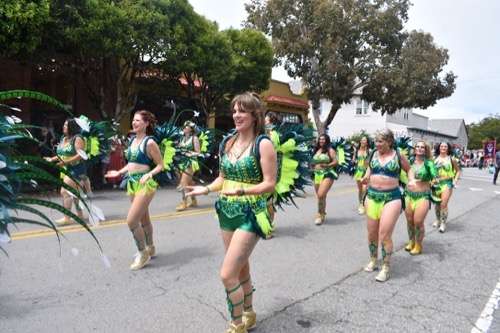
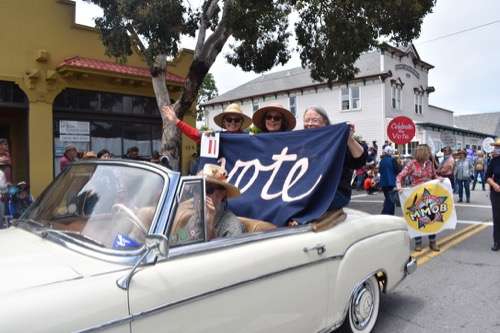
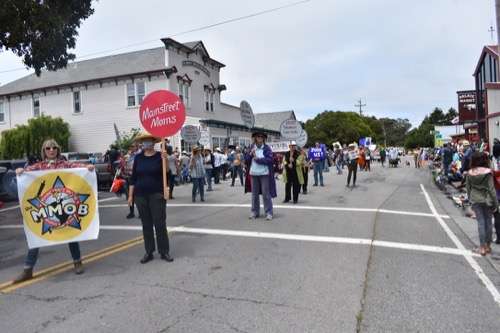
Tomales held its annual Founders Day celebration Sunday with a parade up the main street, which is Highway 1 and which was closed to traffic for the duration. The parade, which keeps getting bigger each year, was followed by a picnic in the Tomales town park.

Firetrucks were a major part of the parade. Most were from the Marin County Fire Department although two were from as far away, so to speak, as Bloomfield in Sonoma County. In a booth at the picnic, Marin County firefighters encouraged Tomales-area residents to join the town’s volunteer fire department. The banner refers to the Marin County Household Disaster Preparedness website.

Steve Kinsey, the Marin County supervisor who represents West Marin, rode in a Lamborghini. He had been originally scheduled to ride on a tractor, but it broke down. Bruce Bramson of Tomales got on the phone for three hours and eventually found Kinsey the elite sportscar for his chariot.

Jeff Etamad of Tunnel Hill Ranch in Tomales led his llama in the parade.

Members of the Redwood Empire Harley Owners Group (HOGS) followed a convoy of firetrucks at the beginning of the parade. The group says that by raffling off a Harley Davidson motorcycle each year, it has raised nearly $1.8 million over the past 10 years for the Meals on Wheels program.

Parading in a truck festooned with sunflowers was the Valley Ford Young Farmers Association. Its president, Anna Erickson, described the association as “a group of us in our late twenties-early thirties. We are made of three farms, Hands Full Farm (being mine), True Grass Farms run by Guidio Frosini, and Swallow Valley Farms run by John Gorman. We grow beef, lamb, pork, chicken, eggs, some produce, cheese, preserves — farmy stuff like that.”

Standing on a balcony above the Continental Hotel, Dru Fallon O’Neill (left) and Bert Crews, both of Tomales, were the parade announcers this year as they have been in the past.

A 1931 Ford Model A roadster pickup owned by the Simoni family of Sebastopol, Sonoma County.

Another Norman Rockwell moment in West Marin: two youngsters and two goats were passengers in the bed of a beat-up, old, farm pickup truck with a KWMR community-radio bumper sticker.

The Tomales High cheerleaders stopped along the route to perform as they marched in the parade.

A shack on a trailer promoted Valley Ford bird houses.

Cameraman at work: Kenzmyth Productions is beginning to film a documentary on Loren Poncia of Tomales. Loren’s parents Al and Cathie Poncia for years operated a dairy ranch, which they eventually converted to a beef ranch, beside Stemple Creek. The ranch was established in 1902 by Al’s grandfather, who immigrated to Marin from Garzeno, Italy, in the 1890s. Loren is the fourth generation to operate the ranch.

Dan Norwood of Dan’s Automotive Repair in Tomales again this year entered a car that fell apart during the parade. Clowns jumped out of the vehicle and put it back together, so it could continue. The entry’s motto was: “If we can’t fix it, we won’t!”

A breakdown in literacy: The Marin County Mobile Library, which was helping bring up the rear of the parade, broke down for real along the route and — after some delays and jokes from the parade announcers — had to be towed most of the way.

The Hubbub Club Marching Band from the Graton-Sebastopol area of Sonoma County was a hit of the parade. At the end of the parade they gave a brief performance at Highway 1 and Dillon Beach Road and then moved on to the beer garden at the William Tell House for a full set.

The Ancient and Honorable Order of E Clampus Vitus marches past the food and crafts booths set up for the picnic in Tomales Town Park. The Clampers, a fraternal organization dedicated to the study and preservation of Western heritage, has memorialized events in Tomales history.

Many picnickers in the park took advantage of a dining tent to escape the heat of the sun.

The band Wagon, whose members hail from Tomales, San Rafael, and Oakland put on a good show for picnickers in the park.

Perhaps because I was born midway through the US involvement in World War II, I’ve always felt an affinity for popular music from that era: We’ll Meet Again by Vera Lynn (1939), In the Mood by the Glenn Miller Orchestra (1940), The Boogie Woogie Bugle Boy by the Andrews Sisters (1941), The White Cliffs of Dover also by Vera Lynn (1942), and many more.

The Andrews Sisters

A particular favorite was an Andrews Sisters swing-jazz song, which I grew up calling My Dear Mr. Shane. I’m sure most of you have heard it at one time or another sung as: “My dear Mr. Shane, please let me explain/ My dear Mr. Shane means you’re grand./ My dear Mr. Shane, again I’ll explain/ It means you’re the fairest in the land.”

But as I discovered while reading about the song not long ago, many of us have had it all wrong. The line isn’t “My dear Mr. Shane” but rather “Bei mir bistu Shein,” which is Yiddish for “To me you’re handsome/beautiful.” It was the first major hit for the Andrews Sisters, who used Germanized spelling in the original title, “Bei Mir Bist Du Schön.” In singing it, however, the Sisters used the Yiddish pronunciation Shein for the word meaning “handsome/beautiful.”

As the story goes, Jacob Jacobs (lyricist) and Sholom Secunda (composer) wrote the song in 1932 for a quickly forgotten Yiddish musical comedy, I Would if I Could. In 1937, the American songwriter Sammy Cahn heard a black group sing it in Yiddish at the Apollo Theater in Harlem and was intrigued by the melody and impressed by the audience’s reaction.

Cahn bought the rights to the song for $30 from Secunda, who split the money with Jacobs. Cahn gave the song English lyrics, and composer Saul Chaplin jazzed up the rhythm. Later that year the Andrews Sisters recorded it, earning them a gold record for more than one million sales.

Soon various versions of Bei Mir Bist Du Schön were being performed throughout Europe, including in Nazi Germany. The song was a hit there too until its Jewish origin was discovered and it was banned.

Ultimately the song grossed $3 million, of which Secunda and Jacobs got very little. In 1961, the copyright expired, and ownership reverted to them. Finally, they began receiving appropriate royalties.

The Star Sisters

The best video I’ve seen of Bei Mir Bistu Shein being performed features a Dutch group, the Star Singers, who included it in a 1983 medley of Andrews Sisters songs. Check it out. It’s good theater as well as good music.

My initially mishearing Bei Mir Bistu Shein as My Dear Mr. Shane is, by the way, a phenomenon called a mondegreen. As I wrote here a year and a half ago, the word mondegreen comes from people misunderstanding a line in an old Scottish ballad, “Thou hae slay the Earl of Murray and laid him on the green,” as “Thou hae slay the Earl of Murray and Lady Mondegreen.”

Another notable mondegreen is a line from a hymn, “the cross I’d bear,” being heard as “the cross-eyed bear.”

In other linguistic matters, researchers from Stanford University have been studying the accents and expressions of residents in various regions of California.

When I was a student at Stanford half a century ago, we were told that in comparison with accents in such places as the Deep South, Boston, and New York, Californians have a neutral accent. We supposedly sound like typical television anchormen. In fact, we Californians don’t all speak English the same way.

The ongoing Stanford study has been taking note of how people in the Central Valley, for example, pronounce various words. Is it wash or warsh? Greasy or greezy? Do they pronounce pin and pen the same way? Significantly influencing Central Valley English, the researchers found, were the “Okies,” who migrated to California during the Dust Bowl.

The researchers also spoke with people in Shasta County, according to a Stanford news report. In Redding, the report noted, they found “a phenomenon called ‘positive anymore,’ where the word ‘anymore,’ historically used only in negative sentences (‘I don’t shop online anymore’), is used in a positive sentence (‘I shop online anymore’).”

I showed the Stanford report to a friend in Inverness who wasn’t impressed. “Seems like a waste of resources to tease out differences which really don’t matter,” he responded. “Who cares about the small differences of white people in California?

“I just don’t see any value in it, except to the linguists who probably received grants. Hard for me to think of anyone outside that narrow field who would applaud the research.”

To me, on the other hand, the research amounts to linguistic anthropology. By their use of language, we can tell where various families came from, even when the current generation isn’t sure. But then, I studied English and Communications at Stanford, so the research probably seems more fascinating to me than to others.

The Jack Mason Museum of West Marin History in Inverness on Saturday unveiled a new exhibit, Inverness Yacht Club. It features photographs from the museum’s archives, as well as a few items loaned to the museum by the yacht club.

The exhibit covers the first Inverness Yacht Club from 1912 through 1940, the in-between years when Del Bender owned the building, the new Inverness Yacht Club of 1949, and the celebration in July 1950 when the club was rededicated. There are also some later photographs.

Meg Linden (right), treasurer of the Jack Mason Museum of West Marin History, and Ann Read with her dog Coco greet guests at the exhibition.

A photo that the late newspaperman Peter Whitney, who had a home at Chicken Ranch Beach, donated to the museum in 1999.

A burgee is the distinguishing flag of a recreational boating organization.

Nautical etiquette holds that members’ boats may fly their burgees while sailing or at anchor, day or night, but not while racing. Or so writes R.L. Hewitt, commodore of the Royal Yachting Association in 1969 and 1984, in Flags and Signals.

Brock Schreiber’s boathouse was built from 1911 to 1914, its wharf in 1908. The boathouse in 1978 was placed on the Register of National Historic Places.

In the early 20th century, weekend travelers to Inverness often got off the narrow-gauge railroad in Millerton and rowed across the bay in skiffs kept on the beach. “Brock Schreiber met the train in a launch if he knew anybody was coming,” historian Jack Mason wrote in Point Reyes the Solemn Land.

“One Inverness pioneer, Mabel Reed Knight, regaled friends for years with her story of getting off the train at Millerton, expecting to be ‘met.’ She shrieked across the mile-wide bay at Schreiber, and unable to raise him, hiked [around the foot of Tomales Bay] the eight miles to Inverness, suitcase and all, ‘with a dog nipping at my heels all the way.’”

“….These years were golden for Inverness. Schreiber’s two launches, the Kemah and the Queen, took excursionists down Tomales Bay; his rental sailboats were at the beck of weekenders.”

Independence Day at Shell Beach in the 1930s.

A sideview of the yacht club with people on the deck circa 1952.

Admiral Chester Nimitz and his wife Catherine at the Inverness Yacht Club in 1950.

During World War II, Admiral Nimitz was promoted to Fleet Admiral of the US Navy and won a series of decisive victories against the Japanese at islands throughout the South Pacific. In 1945 aboard the Battleship Missouri in Tokyo Bay, the admiral represented the United States in signing Japan’s document of surrender.

Aerial view of the Inverness Yacht Club and Cavalli’s pier (at center) in 1956.

The Small Boat Racing Association hosted by the Inverness Yacht Club in 1976.

The Lark, Spring Maid, and Skip Jack in a 1920 race off Brock Schreiber’s wharf.

Jim Barnett (center) racing his Flying Scot in 1980 with his crew.

The exhibit is open the same hours as the Inverness Library, with which it shares its building, Monday from 3 to 6 p.m. and 7 to 9 p.m., Tuesdays and Wednesdays from 10 a.m. to 1 p.m. and from 2 to 5 p.m., Fridays 3 to 6 p.m., and Saturdays from 10 a.m. to 1 p.m.

“Tomales Union High School opened on Aug. 5, 1912, with 23 students and one teacher/principal,” notes a Tomales Regional History Center Bulletin. On Sunday, Aug. 5, the museum opened an exhibit celebrating the school’s last century.

Approximately 300 people, including many former students, packed the history center, which is located in the high school’s former gym in downtown Tomales. The crowd at times was so thick that just getting around in the history center required a litany of “excuse me, excuse me, excuse me.”

The original Tomales High schoolhouse.

The class of 1916 was the first to complete four years at the high school. Teacher Edith Wilkins is at left and principal Benjamin Pratt is at right. Between them are (from left) students Marie Dempsey, Elsie Basset, Truman Fairbanks, Jane Burns, and Vivian Swanson.

Before the two-classroom school was a decade old, it was expanded to 10 classrooms thanks to a $30,000 school bond. “A hyphen-like hallway,” in the words of the history center, connected the new classrooms with the original school.

“The boys locker room in the school’s basement was one of the amenities of the larger school,” notes the history center.

Tomales High’s first school bus was chain-driven. Standing outside the bus is student and driver Harold Maloney, class of 1919. Original photo by Ella Jorgensen.

Tomales High’s third school bus as seen in the 1930s.

Attending Sunday’s opening of the exhibit was May Velloza of Point Reyes, a 1946 graduate of Tomales High and a school bus driver for almost eight years in the 1970s. How did students on the bus behave back then? “I had really good kids,” she replied. “You know why? ‘Cause I knew  the parents.”

Tomales High’s first agricultural teacher, William Reasoner, started the Tomales chapter of Future Farmers of America in 1929. Here is Reasoner with his National Champion dairy-cow judging team in 1931. From left: Reasoner, Neibo Casini, Donato Albini, Donovan Rego, and Ed Williams.

The National Championship trophy.

During Sunday’s opening of the history center exhibit, guests could also get tours of the new high school to see recent construction there.

The California Field Act mandates that all the state’s public schools be earthquake safe, and Shoreline School District trustees in the 1960s were faced with either retrofitting the old school or building a new one.

“Bond elections to finance various options followed and were twice narrowly defeated,” the history center bulletin notes. “One vocal group of residents believed the school should be abandoned altogether and its students dispersed to other, larger schools. Thus the question of Small-local-school versus Larger-more-specialized-school insinuated itself into the referendum process, its echo reverberating to this day.

“Finally in 1967 a third election was successful. Affirmative votes in all precincts except Inverness resulted in an overall 73 percent approval for the $1.1 million bond to finance a new high school. In a busy two years, a piece of property just east of Tomales was purchased from Romero Cerini; architects and contractors were consulted. The trustees worked hard to educate themselves about modern high school design.”

In 1969, the new high school opened along the Tomales-Petaluma Road.

Remnants of the old school. After the new high school opened, the old campus was largely unused, and in November 1977, most of the old school burned in a fire that many people suspected was arson although that was never established.

Left undamaged by the fire was the school’s gym, and in 1998 the building was restored to become the Tomales Regional History Center where the school exhibit is now on display.

Tomales High’s sports teams have done well over the years. The girls volleyball team won its division in 1998.

During World War II, Tomales High sports were limited to intramural games. The history center bulletin explains why:

“Student Kathie Nuckols (Lawson) clearly remembered the Monday morning of Dec. 8, 1941 — little more than 24 hours after Pearl Harbor was bombed. ‘Our principal called all the students… into the auditorium to hear President Roosevelt call our country to war. His voice came through a small radio, and we strained to hear his words, overwhelmed by the drama as only teenagers can be.’

“Blackout shades lowered in the auditorium, tanks passing the school on their way to occupy Dillon Beach, the imposed limits on travel because of gas rationing, especially affecting the sports programs which were, for the duration, limited to intramural games. These are some of the things students of the war years remembered.

“Yet these events were undoubtedly put into perspective by the biggest effect of all, the nine Tomales High students who did not come home from the war.”

The 1946 Tomales High band.

The 1954 band performs at a football game.

The Tomales High band in 1973. The school didn’t hold a nighttime football game until 2004.

Tomales High teams were originally called the Wolves, but in 1950, the name was changed to the Braves. Originally the mascot was symbolized by a cartoon-like Indian, but that image was later changed to the one here. In 2001, Shoreline School District trustees decided the name was disrespectful to Native Americans and voted to change it.

However, many district residents objected, including several Miwok descendants who said the name had been changed to Braves to honor them. A petition signed by 90 percent of the student-body objected to the change, and more than 100 of the school’s approximately 175 students cut class for half a day in protest.

Eventually the trustees voted to keep the name Braves but to drop the Indian image, saying it looked like a Great Plains Indian, not a Miwok.

Sports, agriculture, and sewage. Cows peacefully graze beside the town sewage ponds Sunday afternoon. The bleachers of Tomales High’s ballfield are in the background.

The tranquility of this scene was in sharp contrast to the high-spirited crowd at the history center. The biggest contrast of all, however, occurred a few hours later.

NASA illustration of Curiosity on Mars.

About 10:30 p.m. local time, a global audience went into a frenzy of excitement as NASA scientists endured what they called “seven minutes of terror” and gently landed a sizable exploratory-robot called Curiosity on the planet Mars 154 million miles away. What an historic day!

The Marin County Deputy Sheriffs’ Association held its annual barbecue Sunday at Stafford Lake. There were no reports of rowdy deputies crashing cars or getting in fights with each other. It wasn’t always like that.

A just-released book, Resident Deputy Sheriff In Wild and Wooly West Marin: 1964 to 1969 … and then some!, describes heroism, humor, and scandals within the Marin County Sheriff’s Office four decades ago.

Numerous well-known residents of West Marin play roles in the book: retired Judge Dave Baty of Inverness Park, retired Sheriff’s Sgt. Russ Hunt of Point Reyes Station, the late Sheriff’s Capt. Art Disterheft of Olema (for whom the Public Safety Building in Point Reyes Station is named), and others.

Sheriff’s Capt. Art Disterheft (left) and Sgt. Weldon Travis in Inverness Park during the Storm and Floods of  1982. Portrait copyright Art Rogers/Point Reyes

Written by a retired sheriff’s sergeant, the book provides — among other things — an insider’s look at the sheriff’s office during the 1958-to-1978 tenure of Sheriff Louis Mountanos who, according to the author, “had ties to La Cosa Nostra.”

Weldon Travis, the author, knows West Marin well. He moved to Woodacre after high school, attended the College of Marin, and in the 1960s became a deputy in the county sheriff’s office.

While still a young officer, Travis was made a resident deputy in West Marin, meaning he was patrolling the area where he lived.

Along with accounts of heroism, tragedy, and official wrongdoing, his book includes numerous anecdotes that are humorous in the understated vein of Sheriff’s Calls. But unlike them, he often names names:

“I had a civil paper to serve on George [Gallagher of Nicasio], nothing serious, and went to his house… His wife told me he and a bunch of his friends were deer hunting a few miles away in the canyons along Wilson Hill.

“George was getting along in years, so he was sitting down near the base of a canyon as some of the younger guys were hopefully driving the deer toward the older ones….

“I spotted George’s International jeep and figured I’d find him, hopefully without messing up the hunt. I stayed in the open and moved slowly — didn’t want to get shot by accident.

“Pretty soon I heard a big one come crashing down through the oaks and madrones, then the nearby crack of a rifle. I moved that way and found George sprawled on the hillside between some big rocks. The big ol’ buck had knocked him ass over teakettle downhill.

“George looked up at me with kind of a dazed expression on his face, and in that high voice of his asked, ‘Weldon, how did you get here so quick?’ I just grinned at him.”

Retired Sheriff’s Sgt. Weldon Travis at the Pinecone Diner Saturday.

Another of his stories tells of a naked man high on drugs trying to have sex with a patrol car’s red light as a new deputy from Nicasio, Joe Dentoni, drove around Point Reyes Station.

Still another story tells of stopping a motorist in the San Geronimo Valley “late one summer evening.” Seeing the man’s car wandering around its lane at varying speeds, Travis assumed he was dealing with someone “who was either really sleepy or intoxicated.”

However, when Travis turned on his siren, “up popped a blonde, long-haired woman, sitting bolt upright in the front passenger seat.” After talking with the two and running a warrant check, Travis writes, “I sped off, leaving them to recompose themselves at roadside.”

Some of Travis’ stories are grim. A “cat lady,” who had been dead for several days, was found at home in Woodacre. “The cats didn’t have any food except her.” Travis helped the coroner put her in a body bag although “her forearm skin slipped off as I pulled her off the bed.”

More emotionally wrenching for Travis was arriving at a Lucas Valley Road home just as a resident committed suicide with a gunshot “into his mouth and brain.”

After the coroner had come and gone, Travis “gathered up the blood-soaked quilts, blankets, sheets and pillows and threw them in the trunk of the patrol car.

“The new widow and I got some Clorox from under the sink and got down on our hands and knees together and scrubbed and scrubbed….

“At home, I washed all of that stuff three times, but it was useless. It all went to the dump. My emotions and some of my sanity took a dump too.”

Travis describes the suicide of a fellow officer, as well as his own alcoholism, marital infidelities and indiscretions.

“Why do I share this?” he asks at one point. “So you might understand what we who serve you do. We pay a price, but that’s okay — our choice. And that’s why we drink, have failed relationships, and commit suicide after our usefulness to our society seemingly has been utilized.”

Travis also marvels at the heroic strength of some of the public with whom deputies deal.

In a section titled Abbott’s Lagoon Drifter, the author tells of “two, young lady-friends” who calmly reported that an armed, would-be rapist had accosted them at Abbott’s Lagoon in the Point Reyes National Seashore.

One of the young women had learned martial arts while attending UCLA, and together they took the drifter’s gun away and violently beat him. With help from the public and a marijuana-hunting helicopter, deputies a day later found the man and arrested him.

“He pled guilty and, in view of his extensive rap sheet from across the Midwest, went to prison for a long time,” Travis wrote, adding, “Good community effort!”

Ironically, Travis himself doesn’t tell the story for which he is best known although his book includes an epilogue of news clippings that tell it for him.

In the 1950s while Travis was a “starving student at the College of Marin,” he was hired to pose naked for a photographer who said the pictures would be used in art classes.

Around 1966, after Travis was working for the sheriff’s office, pirated copies of the photos began circulating in the soft-core porn world. Soon they were showing up in gay men’s magazines such as Tomorrow’s Man, Fair Fellows, and Times Square Stud.

Someone (Travis believes it was an organized-crime figure whose toes he had stepped on) brought the photos to the attention of Sheriff Mountanos, who fired him.

“The indiscreet photos would cause the public to lose confidence in him,” the sheriff claimed. The claim, however, was met with a chorus of outrage from members of the public who noted what a good deputy Travis was.

Several people wrote letters to the Marin Independent Journal, saying that nothing about posing nude for an art class disqualified Travis to later work as a deputy.

With Judge Baty defending him, Travis took his firing to the county personnel commission, who reinstated him on a 4-to-1 vote.

The late San Francisco Chronicle columnist Herb Caen at the time wrote that Mountanos had “made himself look fairly ridiculous” and noted that future President Herbert Hoover had helped pay his way through Stanford University by “posing in the raw for art students.”

Weldon Travis and his wife whom he refers to as “Serene Irene, the Bawdy House Queen.”

Travis, now 74, lives in the town of Rough and Ready, Nevada County, where he is married to an 80-year-old “artist, former beauty queen, and model” named Irene.

Once known as a somewhat-hippie deputy, Travis is now a full-fledged-hippie political conservative — sporting long hair, a ring in his ear, and Indian jewelry. How did that change come about?

Irene said they consider themselves “compassionate conservatives… socially liberal and economically conservative.” Above all, the former sheriff’s sergeant is overtly skeptical about the workings of government. Perhaps from seeing them at close range.

Resident Deputy Sheriff is available at Point Reyes Books for $22 hardback and $12 softcover. Non-West Marin residents can find it in some East Marin bookstores and online.

“Did you know that three-colored cats are almost always female? Years and years ago, P.T. Barnum offered $1,000 for a male three-colored cat. He never got one.”

This bit of trivia comes from the 200th edition of The Old Farmer’s Almanac, which was published in 1992. This year we’ve reached the 220th edition.

The almanac has to be some of the most-enjoyable reading anywhere.

For example, here are some “actual quotes from accident reports submitted to insurance companies by hapless policy holders, as collected by the United Services Automobile Association.”

They were reprinted in the 200th edition:

• “Coming home, I drove into the wrong house and collided with a tree I don’t have.”

• “The guy was all over the road. I had to swerve a number of times before I hit him.”

• “I pulled away from the side of the road, glanced at my mother-in-law, and headed over the embankment.”

• “I had been driving for 40 years when I fell asleep at the wheel and had an accident.”

• “The telephone pole was approaching. I was attempting to swerve out of its way when it struck my front end.”

In the words of Wikipedia: “The Old Farmer’s Almanac is a reference book that contains weather forecasts, tide tables, planting charts, astronomical data, recipes, and articles on a number of topics including gardening, sports, astronomy and farming.

“The book also features anecdotes and a section that predicts trends in fashion, food, home décor, technology and living for the coming year. Released the second Tuesday in September of the year prior to the year printed on its cover, The Old Farmer’s Almanac has been published continuously since 1792, making it the oldest continuously published periodical in North America.”

The paperback copies always come with a hole punched through the upper left corner to make it easy to hang the almanac on a nail in outhouses and, later on, in bathrooms. For centuries, both have doubled as reading rooms. And in emergencies, the almanac’s light-weight pages have been substituted for toilet paper. Or so I read.

At the time John B. Thomas launched The Farmer’s Almanac, there were many competing almanacs around. When his outlived the rest, Thomas in 1832 changed the name to The Old Farmer’s Almanac but dropped the “Old” in 1836. Thomas died in 1846, however, and in 1848, the name reverted to The Old Farmer’s Almanac.

The Old Farmer’s Almanac formula for predicting weather is kept locked in a black tin box at the company office in Dublin, New Hampshire.

For his weather predictions, Thomas studied solar activity, astronomy cycles and weather patterns. He used his research to develop a secret forecasting formula, which is still in use today. Other than the almanac’s prognosticators, few people have seen the formula. It is kept in a black box in the almanac’s office.

During World War II, a German spy was caught in New York with a copy of the 1942 Old Farmer’s Almanac in his pocket. As a result, the almanac from 1943 through 1945 featured “weather indications” rather than “forecasts” in order to comply with the U.S. Office of Censorship’s voluntary Code of Wartime Practices for press and radio. The temporary change allowed the almanac to maintain its record of continuous publication.

Old Farmer’s Almanac founder John B. Thomas at right.

While many people buy The Old Farmer’s Almanac for its cooking and gardening tips, its bizarre tales (all supposedly true) have since its founding been a primary attraction. Take this story written by Bernard Lamere:

“During the Civil War, Union doctor Capt. L.G. Capers was acting as a field surgeon at a skirmish in a small Virgina village on May 12, 1863. Some distance to the rear of the captain’s regiment, a mother and her two daughters stood on the steps of their large country home watching the engagement, prepared to act as nurses if necessary.

“Just as Capt. Capers saw a young soldier fall to the ground nearby, he heard a sharp cry of pain from the steps of the house. When the surgeon examined the infantryman, he found that a bullet had broken the fellow’s leg and then ricocheted up, passing through his scrotum.

“As he was administering first aid to the soldier, Capt. Caspers was approached by the mother from the house to the rear. Apparently one of her daughters had also been wounded. Upon examining the young woman, Caspers found a jagged wound in her abdomen, but he was unable to tell where the object had lodged.

“He administered what aid he could for such a serious wound, and he was quite pleased to see that she did recover from the injury. Thereafter it was a full eight months before the captain and his regiment passed through the same area, at which time he was quite surprised to find the young woman very pregnant.

“Within a month, she delivered a healthy baby whose features were quite similar to those of the young soldier who had been wounded nearly at the same instant the girl had been struck nine months earlier.

“The surgeon hypothesized that the bullet that struck the soldier had carried sperm into the young woman’s uterus and that she had conceived.”

The denouement was that the “soldier and young woman courted, fell in love, and married, later producing two more children using a more common method.”

One of the amazing aspects of The Old Farmer’s Almanac is how inexpensive it has always been. You can buy a copy for only $5.99 online from the publisher or a hardcover edition for only $7.98. I received my 200-year-anniversary copy as a gift from colleagues, and it really is a wonderfully entertaining gift for yourself or a friend.

Through June 30, the Jack Mason Museum of West Marin History in Inverness is exhibiting an “historical view” of Inverness Park. Although the Census Bureau and the Postal Service lump the town in with Point Reyes Station, Inverness Park is far older.

Much of the area was once owned by Rafael Garcia, who in 1836 was issued a Mexican land grant for three square miles at Bolinas. In 1843, he moved his ranch further north so that his brother-in-law Gregorio Briones could have the land in Bolinas. Mexican authorities subsequently granted Garcia “judicial possession” of his new holdings.

However, in 1860, two lawyers from Vermont, Oscar and James Shafter, claimed that 9,000 acres of Garcia’s northern holdings actually belonged to them. They argued that they had acquired adjacent holdings which supposedly included Garcia’s land. The dispute, of course, went to court, and after six years of intense litigation, Garcia’s ownership was finally upheld on Feb. 21, 1866.

“Whatever joy it gave Rafael Garcia was short lived,” the late historian Jack Mason wrote in his book Point Reyes the Solemn Land. “Within 10 days, the old man was dead, his inquisition over.” He was 74.

A water tank at White House Pool collapsed in the 1906 earthquake.

Somewhat surprisingly, Garcia descendants had once operated a dairy where the county parking lot for White House Pool is today. There was also a second dairy in Inverness Park.

The Lockhart family operated Pinecrest Dairy near the top of Balboa Avenue (where it turns into Drakes Summit Road) until 1961. The dairy, which is across the street from the former St. Eugene’s Hermitage, is now occupied by Doug and Margaret Moore. The dairy barn is still intact but not visible from the road.

The center of Inverness Park has always been its grocery stores. This is how the first store, which also sold gasoline, looked after it was remodeled in the 1930s.

In the 1920s, Michael and Filomina Lucchesi Alberigi “bought about five acres on the marsh side of Inverness Park and moved into a large home there,” the museum publication Under the Gables reports. “They built barns behind the house. They grew vegetables and eventually used a small house next to their home as a general store. Later it also had a small café and became the social hub of the village.”

In 1949, the Alberigi family leased the old store to Annie and Victor Turkan to run while the Turkans built a larger store across the street.

This is the cover photo of the Spring 2012 issue of Under the Gables, which is devoted to the Inverness Park exhibit. Here’s what the new store, which would become Perry’s Deli, looked like in its early days.

“After the Turkans retired, their daughter Wilma Van Peer — who lived next door in what is now Spirit Matters and had the first television set in Inverness Park — ran it,” Under the Gables notes.

“In the 1960s, Vern and Diane Mendenhall bought it from Van Peer and expanded it to include a diner made out of a railway car. Greg (last name unknown for now) bought it from the Mendenhalls and later sold it to Bill and Irene Keener. The Keeners sold it to Dan Thompson over 30 years ago.

“In the early 1970s, the diner was a pizzeria. It then became a succession of bakeries under various names and owners: Foggy Mountain Bakery run by Mountain Girl (Jerry Garcia’s first wife) with Kate Gatov and Irene Keener; Kate sold out to the Keeners, and it was briefly known as Bill’s Bakery; [Station House Café founder] Pat Healy for a brief time; Knave of Hearts Bakery run by Matthew and Robin Prebluda; Debra’s French Bakery (Debra had partners with Brigit Devlin in starting the Bovine Bakery in Point Reyes Station); and now the Busy Bee Bakery.”

The old store, which the Turkans closed after their new store opened, became ranchworker housing for the neighboring Giacomini dairy.

Eventually, however, it  fell into disrepair (as can  be seen at right).

By then, the federal government owned the site.

The National Park Service tore the old building down in 2007 and in 2011 erected a kiosk where it had been.

The kiosk (at left), is across Sir Francis Drake Boulevard from Perry’s Deli.

It provides information on the Park Service’s efforts to return the Giacomini ranch to wetlands.

It also displays minutes of an Inverness Park Association meeting a year ago when the kiosk was discussed. The National Park Service, president Donna Larken noted, had said its work on the kiosk was done although benches (visible above) in the kiosk had not yet been installed.

Another bit of Inverness Park history that has also disappeared is the California Trout Farm.

It was built in 1910 on Fish Hatchery Creek (next to Portola Avenue) and had a contract to supply the California Department of Fish and Game with trout. Individual fishermen could also come to catch and barbecue their fish.

The hatchery closed during the Great Depression but was revived and restocked in 1949.

In the foreground are Rose Alberigi and her daughter Edna with an unidentified boy during the early days of the hatchery.

The revived trout farm didn’t last long, and its concrete ponds were torn down in the 1950s. “There is part of one pond left, but it may be from an even earlier operation,” Under the Gables explains.

The Inverness Park photographic exhibit at the museum was in large part organized by Meg Linden with photos drawn from several collections. The museum is open whenever the Inverness Library, which shares its building, is open: Monday from 9 a.m. to 6:30 p.m., Tuesday 9 a.m. to 6:30 p.m., Wednesday 10 a.m. to 6:30 p.m., Thursday 9 a.m. to 8 p.m., Friday 9 a.m. to 6:30 p.m. and Saturday 9 a.m. to 6:30 p.m.

The posting that follows is not a history of the North Pacific Coast Railroad or its successors, the North Shore Railroad and the Northwestern Pacific. Rather it consists of a few glimpses of the wondrous line as it evolved over 58 years and then for the most part faded away.

More than half the towns in West Marin grew up along the tracks of the North Pacific Coast narrow-gauge railroad. In 1875, the line opened between the Sausalito ferry terminal and Tomales by way of Point Reyes Station. Soon it was extended to Cazadero’s logging camps.

The narrow gauge makes a morning stop in Lagunitas around 1915. By then, the tracks east of Manor (now part of Fairfax) had been converted to standard gauge with an electrified third rail powering the locomotives.

In order for trains to travel between the San Geronimo Valley and Manor, the narrow gauge required two tunnels to get through Whites Hill: “a small one at the bottom behind White Hill School and the longer one at the top, which passed directly under the current [Sir Francis Drake Boulevard] pass,” historian Dewey Livingston of Inverness told me.

These were replaced in 1904 by the Bothin Tunnel on the south side of Woodacre. The Bothin Tunnel was sized to accommodate standard-gauge railroad cars, which in 1920 took over the stretch from Point Reyes Station east to Manor.

After the standard gauge shut down in 1933, the Bothin Tunnel remained open — primarily for fire engines from the county fire department in Woodacre en route to fires in East Marin. After many years, however, the Bothin Tunnel was closed by a fire and cave-in, Livingston added.

A northbound train crosses the Point Reyes Station trestle.

A particularly wretched part of the line was this trestle over Papermill Creek immediately east of Point Reyes Station. A sharp curve in the tracks just west of the creek was followed by a reverse curve on the trestle itself.

On June 21, 1903, one of the worst wrecks in the railroad’s history occurred at the trestle.

A special train had been chartered to carry friends of Warren Dutton, a founder of Tomales, to the town for his funeral. Returning southbound, the train, which had been traveling fairly fast all the way from Tomales, crossed the trestle a little too fast.

The engine and its coach fell off the trestle and landed upside down, killing two passengers. Four other passengers and the conductor were badly injured. Just three days later, another train ran off the tracks in nearby Tocaloma, crushing the engineer beneath the cab.

Three years later, the Point Reyes Station trestle experienced more misfortune when it was severely twisted (left) by the 1906 earthquake.

The trestle, however, was quickly repaired.

Similar damage occurred in Tomales and along the railroad bed beside Tomales Bay.

As the late railroad historian Bray Dickinson of Tomales noted in his 1967 book Narrow Gauge to the Redwoods, “Anticipating a big summer business, the narrow gauge company intended to start a new schedule on the day of the earthquake.

“The San Francisco morning newspapers — never delivered because of the catastrophe — carried the North Shore timetable which provided a record four passenger trains daily to Cazadero and two additional locals for Point Reyes Station.”

In Tomales, the quake caused a hillside to collapse, tangling the tracks.

In the railroad’s early days, Tomales was the most prosperous West Marin stop, and nearby hamlets were also bustling places. Here a giant round of cheese awaits being picked up in 1894 at the train platform in Fallon.

In the 1890s, Engine 13 wrecked at Clark Summit just north of Fallon. The site is now part of Clark Summit Farm, an organic beef, pig, and chicken operation owned by Liz Cunninghame and her husband Dan Bagley.

Nowadays, most motorists on Highway 1 south of Tomales are familiar with these steel piers, which once held up a trestle spanning Keys Creek.

Far fewer people, however, have any idea how the trestle looked when it carried trains. In fact, remnants of the old railroad provide only a hint of the grand system it was.

For motorists heading north on Highway 1 from Point Reyes Station, the first turnout where they can stop and view Tomales Bay overlooks what was once a commercial area known as Bivalve. This long-gone oyster building was Bivalve’s dominant structure.


North of Bivalve, the old railroad bed along the shore is barely discernible these days.

In railroad days, however, this approach to Bivalve was a scenic part of the trip.

South of Bivalve, the railroad bed skirted a small lagoon as it crossed to Railroad Point on Martinelli property.

I know the spot well, for the late Sheriff’s Capt. Art Disterheft and I were once kayaking in the lagoon when we discovered we were virtually trapped by a strong incoming tide through the entrance channel (foreground at right).

We finally escaped by paddling frantically only to then hear someone on the turnout above us laughing loudly at our predicament.

The photo at right of a southbound train leaving Bivalve en route to Railroad Point was shot in June 1906. “This was two months after the great earthquake, which badly damaged this section of line along Tomales Bay,” Dickinson noted.

“Repairs had been rapidly made and regular trains were running over the entire line within three weeks. Uneven track ahead of Engine 3 marks quake damage.”

Although the tracks heading east from Point Reyes Station were converted to standard gauge in 1920, the tracks north of town remained narrow gauge. In 1930, the narrow-gauge section shut down, and in 1933, the standard-gauge section did too.

Much of the material for this posting comes from Dickinson’s book Narrow Gauge to the Redwoods. Anyone who lives in West Marin and is interested in its history should have a copy. The book was edited by historian Ted Wurm, who died in 2004, while most of its photos are from the late Roy Graves’ collection.

Point Reyes Station’s “birth can be pinpointed: Jan. 7, 1875, the day the first train came through on its way to Tomales,” the late historian Jack Mason of Inverness wrote in Earthquake Bay, A History of Tomales Bay, California (North Shore Books, 1976).

The train’s “first sightseers viewed Olema Station (its name for seven years) with unbelieving dismay. ‘The depot is in a wilderness!’ one of them wrote. And so it was — 11 acres of Mary Black Burdell’s cow pasture: no hotel, no sandwich stand or saloon.

“To reach Olema two miles distant, where many were headed, was well nigh impossible, with Papermill Creek to cross and no bridge or stageline,” Mason wrote. Back then Olema, whose downtown was much larger than it is today, was the commercial hub for the foot of Tomales Bay. It boasted two restaurants, two hotels, six bars, a racetrack, a school, a Catholic Church, and a Druids Hall.

In less than a year, a bridge providing access to Olema was built across Papermill Creek, but by that time, Mason observed, “passengers had a hotel nearer at hand …. ‘with the only saloon serving a vast and thirsty land.’” The hotel and saloon, which Dr. Galen Burdell built, were right across the street from the train depot.

Dr. Galen Burdell’s saloon.

Mary Black Burdell was married to dentist Galen Burdell and was the daughter of rancher James Black of Nicasio. Black Mountain, which provides the backdrop for Point Reyes Station, is named after him. In 1961, the site of Black’s ranch house was inundated by the completion of Nicasio Reservoir, but whenever the reservoir runs dry during droughts, the house’s foundation can still be seen on the western shore.

When the train depot opened in Mary Black Burdell’s pasture, Black had been leasing land nearby to former Sheriff James T. Stocker, who operated a dairy ranch on it. Today, “Stocker’s ranch site is marked by the cypress trees right across Highway 1 from Campolindo Road and [by] a couple of fruit trees,” Dewey Livingston, the reigning historian of Inverness, told me. “They all overlooked Tomasini Creek.” This this no doubt explains why Tomasini Canyon, where the old sump was located, for years was known as Stocker’s Gulch.

In the area around the depot, Mrs. Burdell gave her husband 950 acres of land she had inherited. The property would become the site of Point Reyes Station, and until the dentist’s death in 1906, “the town was his plaything,” wrote Mason. “By 1880, Burdell’s Station, as some called it, had all the appurtenances of civilization: a blacksmith shop, livery stable and butcher shop.”

A small school was erected in 1879, but in 1905 it was replaced by Black School (above), which was named after Mary Burdell’s father. The wooden, two-story structure was located where the firehouse is today.

The first store in town was built in 1883 at Second and A Streets by A.P. Whitney and Company of Petaluma but was sold four years later to Salvatore Grandi. The “Swiss farmer,” as Mason described Grandi, turned the business into a general store called Grandi’s Mercantile Company.

(It should be noted there is no street named Main Street in Point Reyes Station. The correct name for the main street is A Street — or, if you prefer, Highway 1.)

The first post office opened on May 23, 1882, and the town changed names from Olema Station to Point Reyes the same day. The town’s name changed again — to Point Reyes Station — on Aug. 10, 1891, so its mail wouldn’t accidentally be sent to the post office at F Ranch on Point Reyes.

As Dr. Burdell developed Point Reyes Station, he wrote a covenant into the deeds for all the lots he sold, prohibiting anyone else from operating a saloon in town. Grandi, however, broke Dr. Burdell’s monopoly by opening a second saloon in 1902. The dentist sued, but in 1907 the state supreme court ruled in Grandi’s favor; Dr. Burdell, however, had died the previous year.

Grandi himself already had competition of his own to contend with. In 1898, one of his clerks, Peter Scilacci, opened a general store further north on A Street. Scilacci’s emporium was bigger than Grandi’s and included a livery stable and a grain warehouse.

The Bank of Tomales in 1910 bought land on the main street for a branch; over time, the bank would relocate and go through several ownerships and name changes en route to becoming a branch of Wells Fargo. Just before World War I, the Foresters of America built a hall, which still stands on Mesa Road just north of the Old Creamery building. In 1914, a small Catholic Church opened on B Street.

The masonry-built Grandi Company building had collapsed in the 1906 earthquake, and Grandi replaced it with a wooden building that is “now the upper story of the Western [Saloon],” Livingston told me. Two years later, Grandi retired and sold his nephew Reno Grandi and Reno’s partner Joe Codoni property across Second Street from the wood building. There they built the large, brick Grandi Building, which is now unfortunately empty and in disrepair.

The main street of Point Reyes Station in 1920 with the brick Grandi Building at left and the depot at right.

In its heyday, the Grandi Company sold everything from pianos to cattle feed, and in time it developed a policy of never raising the price on goods once they were in stock. Some items, such as stove-heated irons for ironing clothes, remained in stock for decades.

The upstairs of the Grandi Building was a hotel, along with a dance hall. The hotel was mostly used by railroad men, but lieutenant-colonel Dwight Eisenhower stayed there in 1940, just 12 years before he was President Eisenhower. For awhile the town’s telephone switchboard was in the hotel’s lobby. “The hotel closed around 1950,” Mason wrote.

The narrow-gauge railroad, which had been built to carry lumber from Cazadero in Sonoma County to the ferry docks in Sausalito and to return with supplies from San Francisco, was never profitable. It was reorganized several times and eventually became part of the Northwestern Pacific. But the advent of competition from trucks for hauling cargo and from cars for carrying people was too much for the railroad.

In 1920, the NWP converted the track east of Point Reyes Station to standard gauge. (It took the narrow gauge 477 cars to haul what the standard gauge could haul with 198.) But the new arrangement turned out to be inconvenient. Cargo passing through Point Reyes Station had to be unloaded from narrow-gauge cars and onto standard-gauge cars or vice versa.

In 1930, the narrow-gauge line to the north closed down, and in 1933, the standard-gauge line to the east followed suit. For a time, old rail cars were stored in Point Reyes Station, but many were eventually burned. The old engine house became a community center, and the depot is now the town post office.

I am indebted to historian Jack Mason’s Earthquake Bay  for much of the foregoing information.

« Previous PageNext Page »