Photography


Past postings are numbered in the order they went online, with the most recent postings located immediately below the Table of Contents.

To go directly to stories without scrolling, click on the highlighted phrases following the numbers.

Weekly postings are published by Thursday.

262. Crafting the Considerate House

261. West Marin remembers Duane Irving

260. The art of boating

259. Firefighters in action

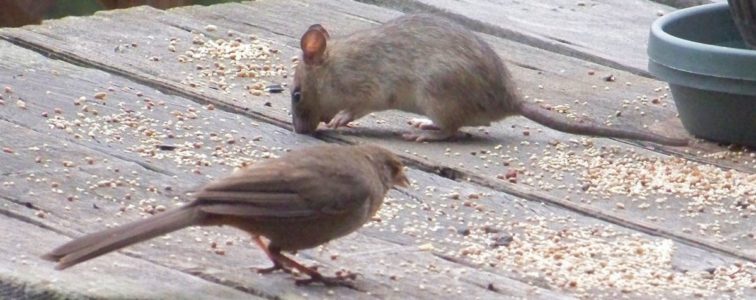
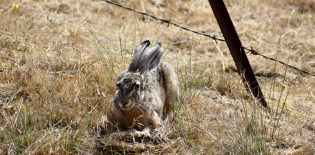
258. Do you like coyotes and bobcats? How about rats?

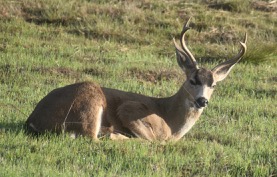
257. Los mapaches con cacahuates; también fotos de los cuervos y venados

256. Proposal for ceasefire in West Marin ‘newspaper war’

255. The young creatures of summer

254. Eli’s coming — causing momentary dismay at The Point Reyes Light

253. Under the volcano and in the eye of the storm — a firsthand account

252. The duel between The Point Reyes Light and The West Marin Citizen

251. Santa Muerte and El Cadejo

250. Wildlife around my cars on the Serengeti Plain of West Marin

249. A big Western Weekend Parade in li’l old Point Reyes Station

248. 4-H Fair and Coronation Ball keep alive Western Weekend’s agricultural traditions

247. A tail for West Marin to bear in mind this Western Weekend

246. Point Reyes Light sells and will incorporate as a nonprofit

245. Point Reyes Station area blackout rumored to have been sparked by bird

244. Planned Feralhood desperate for a new home

243. John Francis takes a walk down under

242. A day in a small town

241. Point Reyes Station’s notorious curve is scene of yet another vehicle crash

240. The Mother Goose method for getting rid of thistles

239. A benefit so that handicapped kids can go rafting

238. Where angels fear to tread

237. The Chronicle, hang gliders, and horses

236. Crowd celebrates 80th birthday of Marshall artist-political activist Donna Sheehan

235. A classic revisited

234. Nature celebrates spring

233. More on diplomatic news we’ve been following

232. Sportscar flies off embankment; no one hurt in miraculous landing

231. A chat with the Trailside Killer

230. Life and death on my hill

229. Valentine’s Fair raises money for Haiti relief

228. Historic irony as milk truck overturns in Marshall

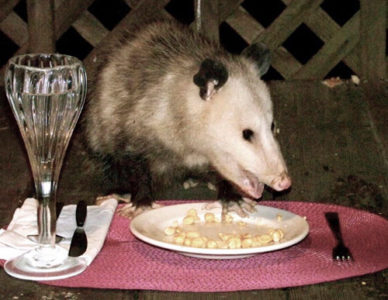
227. Encouraging my bodhisattva possum on her path to enlightenment

226. Benefit for Haitian earthquake survivors filled with mixed emotions

225. What drought? Nicasio Reservoir overflows

224. Disconcerting standup reporting

223. The storms begin; schools close; a near miss at my cabin

222. Spare the rodent (or rabbit) & spoil the diet

221. Lookin’ out my backdoor: some of my favorite wildlife photos

220. Careening through the holidays

219. Chileno Valley journalist working in Abu Dhabi brings new wife home for visit

218. Just what would Mayberry be like on acid?

217. The foxes of downtown Point Reyes Station

216. Interpreting dreams

215. Let’s talk turkey

214. You’ll Never Walk Alone — an unlikely story

213. A wistful walk on the bottom of Nicasio Reservoir

212. Progress in the backyard peace process

211. John Francis leaving; 4 other artists turn pages but sticking around

210. What we inherit

209. Over 200 show up at fundraiser to help pay injured ad manager’s medical bills

208. A community helping one of its own

207. A country mouse in the Tenderloin

206. News of the week reported through pictures

205. Update on injured ad manager of West Marin Citizen; benefit planned; and will there be a race?

204. Startling weather; amazing stepdaughters

203. Talented-animal tales

2o2. Saga of The West Marin Citizen ad manager’s recovery spreads around the globe — not always accurately

201. And you were there

200. Hospitalized ad manager of West Marin Citizen coming home; friends volunteering to provide meals

199. Scenes from the Inverness Fair

198. Great progress for injured ad manager of The West Marin Citizen despite problems with convalescent hospital

197. Thieves use ruse to clean out till at Station House Gifts

196. Anastacio’s Famous BBQ Oyster Sauce goes on sale

195. A hillside of wildlife

194. Kaiser Permanente’s ‘Sicko’ machinations shock injured ad manager of The West Marin Citizen

193. Immobilized by multiple injuries, ad manager keeps selling from hospital bed

192. All creatures feathered and furry

191. The wildlife of summer around my cabin & an update on Linda Petersen’s condition

19o. West Marin Citizen advertising manager hurt in crash; her popular dog Sebastian dies

189. Sunday’s Western Weekend Parade

188. The Western Weekend Livestock Show

187. Western Weekend parade will be Sunday despite reports to the contrary

186. The purple couch beside the road

185. A funny thing happened at the car wash Friday & other odd events

184. My brush with a badger

183. Scientists find no evidence oyster farm harming Drakes Estero; more likely restoring it

182. Why bottom of Drakes Estero can never become part of a wilderness area

181. Badger, Ratty, and the sensual raccoon

180. ‘And how the wind doth ramm!/ Sing: Goddamm — Ezra Pound

179. A tailgate gallery of bumper-sticker humor; Point Reyes weather both Arctic & tropical

178. Crowd in Inverness Friday calls for reviving park’s Citizens Advisory Commission

177. Flying over Northwest Marin

176. Spring meditations in a Miwok cemetery concerning the news of West Marin.

175. Two warning signs of Spring

174. Tomales may be little but it’s lively

173. Doe stalks cat; raccoon emulates Scripture — for the rain it raineth every day

172. Three-year drought comes to a symbolic ending as Nicasio Reservoir overflows

171. Pot busts at my cabin — again

170. Happy Valentine’s Day (as it’s evolved)

169. Blogging about blogging

168. Thinking about words

167. Point Reyes Station celebrates President Barack Obama’s inauguration

166. A reader in Ghana

165. The bittersweet story of a hardy little tree

164. A parting look at 2008

163. Blackout hits Tomales Bay area

162. Nature’s Two Acres Part XXXVIII: Way Out West in West Marin

161. Chileno Valley Ranch as depicted by a rancher-artist who lives there

160. Nature’s Two Acres XXXVIII: This time it’s a tale of two bobbed cats

159. Thanksgiving in Point Reyes Station

158. Nature’s Two Acres Part XXXVII: a bobcat at my cabin

157. Quotes Worth Saving II

156. Nature’s Two Acres Part XXXVI: The migrating birds of fall; or ‘Swan Lake’ revisited

155. Election night euphoria

154. The fun and anxiety of preparing for a disaster

153. Porky Pig, Demosthenes, Joe Biden, and ‘K-K-K-Katy

152. The political zoo.

151. Nature’s Two Acres Part XXXV: Mr. Squirrel

150. A coyote at my cabin

149. Preparing for the fire season

148. Telling the Raccoon ‘Scat’

147. Faces from the weekly press

146. Tomales, Tomales, that toddling town

145. How park administration used deception & sometimes-unwitting environmentalists to harass oyster company with bad publicity

144. Nature’s Two Acres Part XXXIII: Photographing wildlife indoors and out

143. What government scientists elsewhere had to say about the park’s misrepresenting research to attack oyster company

142. Landscape photos & paintings in Stinson Beach

141. What’s in the Inspector General’s report on the park that newspapers here aren’t telling you

140. Point Reyes National Seashore Supt. Don Neubacher seen as ’scary’

139. A demonstration to save Point Reyes National Seashore deer; park administration dishonesty officially confirmed

138. The good, the bizarre, and the ugly

138. Alice in ‘Wilderness

137. Nature’s Two Acres Part XXXII: The first raccoon kits of summer

136. Nature’s Two Acres Part XXXI: The pink roses of Point Reyes Station

135. Nature’s Two Acres Part XXX: Baldfaced hornets

134. Scenes from my past week

133. Artist Bruce Lauritzen of Point Reyes Station draws a crowd for opening of exhibit

132. Kite day at Nicasio School

131. Sunday’s Western Weekend Parade in photos

130. Early projections hold: Obama, Woolsey & Kinsey win… Leno easily bests Migden & Nation

129. Western Weekend’s 4-H Livestock Show fun — but smaller than ever

128. Humane Society of the US says National Seashore claims about deer contraception are misleading

127. Lt. Governor John Garamendi joins battle to save fallow & axis deer in Point Reyes National Seashore

126. Nature’s Two Acres Part XXIX: Cold-blooded carnality… Or, why be warm blooded?

125. Nature’s Two Acres XXVIII: The first fawns of spring

124. The Beat Generation lives on at the No Name Bar

123. ‘Still Life with Raccoon

122. Nature’s Two Acres XXVII: Animals about town.

121. Newspaperman from Chileno Valley describes his life in the United Arab Emirates

120. Point Reyes Station and Inverness Park demonstrators call for a pedestrian bridge over Papermill Creek

119. Seeing history through newsmen’s eyes…. or the pen is mightier than the pigs

118. Five Faces of Spring

117. Supervisor Steve Kinsey defends further restrictions on woodstoves in West Marin

116. Prostitution in New York, Reno, and Point Reyes Station

115. A country without the decency to ban torture

114. National Seashore’s slaughter of deer traumatizes many residents here; ‘we demand a stop’

113. A tale of Kosovo, West Marin, and a bored battalion of Norwegian soldiers

112. Dillon Beach sewage spill update

111. ‘Drive-by journalism’

110. Sewage spills into ocean at Dillon Beach

109. Nature’s Two Acres XXVI: Which came first, blacktail or mule deer? Hint — their venison is oedipal

108. Nature’s Two Acres XXV: Talking turkey

107. Here’s hoping ‘the goose hangs high this Thursday for Valentine’s Day

106. Signs of bureaucratic contamination

105. A final thought about the Caltrans worker who just did his job — and saved the day

104. Statewide campaign to legalize hemp and marijuana comes to Point Reyes Station

103. Heavy news media presence briefly halts axis-deer slaughterin the Point Reyes National Seashore

102. Storm damage bad but could have been tragic

101. Nature’s Two Acres XXIV: Buffleheads, Greater Scaups, and the 16.6 million wild ducks shot annually

100. Lawsuits against and by Robert Plotkin settled out of court

99. Nature’s Two Acres XXIII: Bambi, Thumper, and Garfield

98. Governor Schwarzenegger’s proposal to close Tomales Bay State Park to save money could prove expensive

97. Old Christmas trees, wild turkeys, and the famous cat-and-rat scheme

96. Blackouts, newspapers in the news, and poetic frustration on the prairie

95. Hurricane-force wind & heavy rain take heavy toll on West Marin

94. Marin County gets a bum rap from itself

93. ‘Eco-fascism in the Point Reyes National Seashore

92. Guess who came to Christmas dinner

91. Yuletide greetings from Santa Claws

90. Assemblyman Jared Huffman’s ominous mailer

89. Nature’s Two Acres XXII: They’re hundreds of times more deadly than cynanide… and headed this way

88. Non-native species stops traffic in Point Reyes Station

87. Blackouts bedevil Point Reyes Station area

86. Urban legends

85. Nature’s Two Acres XXI: Coyote influx benefits some birds around Point Reyes Station

84. Winter Moon Fireside Tales — an undiscovered gem draws only four ticketholders opening night (but more for second show)

83. Striptease in Point Reyes Station… well, sorta

82. Our Lady of the Chutzpah — the many faces of State Senator Carole Migden

81. Stefanie Pisarczyk (AKA Stefanie Keys): a woman of two worlds

80. Point Reyes Station’s ‘Path of Lights’

79. Lessons to be learned from the oil spill

78. Nature’s Two Acres Part XX: Where coyotes howl and raccoons roam free

77. West Marin Community Thanksgiving Dinner celebrated in Point Reyes Station’s Dance Palace

76. Giving thanks for an abundant harvest

75. Being a Gypsy isn’t enough; KPFA fires host criticized for not being a ‘person of color’

74. Nature’s Two Acres Part IXX: ‘Things that go bump in the night’

73. Point Reyes Station pharmacist decries health-insurance practices

72. Farm Bureau president quits; defends independence of wife who disagrees with his political position

71. Ship hits Bay Bridge; spilled oil drifts out Golden Gate and mires birds on West Marin coast

70. California photo book’s release celebrated with gala on Inverness Ridge

69. Coastal Post’s December issue to be its last, assistant editor says; publisher contradicts her

68. West Marin’s ‘Mac Guru’ leaving town — a friend with a knack for surviving

67. One last warm weekend before the season of darkness

66. Ranching matriarch Hazel Martinelli dies at 101

65. Nature’s Two Acres Part XVIII: Seasonal sightings

64. White House Pool: a public park where management listens to the public

63. Tuesday’s Marin County Farm Bureau luncheon for politicos

62. Hawks on the move

61. Point Reyes Station’s Hazel Martinelli celebrates 101st birthday with party at son’s deer camp

60. Vandals dump sewage at West Marin School

59. Paving Point Reyes Station’s main street at night

58. Bolinas firehouse and clinic opening party Sunday

57. Nature’s Two Acres XVII: As seen by an old, almost-blind dog

56. Despite public-be-damned management, it’s still a beautiful park.

55. Language, politics & wildlife

54. Truth becomes an endangered species at the Point Reyes National Seashore.

53. ‘Possums,’ a sequel to the musical ‘Cats’

52. The KWMR/Love Field ‘Far West Fest’

51. Quotes Worth Saving & the Inverness Fair

50. Watching the Point Reyes National Seashore obliterate cultural history

49. Congress sees through Point Reyes National Seashore claims

48. Music, wildlife, and the cosmos

42. Garbage in, garbage out

41. 76-year-old Nick’s Cove reopens

40. What we didn’t celebrate on the Fourth of July

39. Ship’s flare or meteor

38. The death of a salesman: Andrew Schultz

37. Preventing fires at home while The Point Reyes Light feels the heat

36. Monday’s demonstration against The Point Reyes Light

35. Inverness Park fire Friday razes art studio

34. Western Weekend retrospective; anonymous satire of Point Reyes Light distributed at parade; Light’s use of unpaid interns may run afoul of labor laws.

33. Sunday’s Western Weekend parade and barbecue

32. Many fail to find Western Weekend livestock show; a new newpaper debuts in West Marin; The Point Reyes Light reports a former bookkeeper is in jail on embezzlement charges.

31. Nature’s Two Acres Part XVI: A gopher snake & other neighbors

30. New newspaper to be published in West Marin

29. Mermaids, cows, Horizon Cable, and Russia’s Internet war on Estonia

28. Nature’s Two Acres Part XV: ‘Among animals…one finds natural caricatures.’

27. Nature’s Two Acres Part XIV: ‘The world, dear Agnes, is a strange affair.’

26. Sheriff Bob Doyle ’stays the course’ despite blunder and gets county government sued.

25. Nature’s Two Acres Part XIII: ‘Who’s the Head Bull-Goose Loony Around Here?’

24. Nature’s Two Acres Part XII: April showers ‘cruel’ with ‘no regrets’

23. Nature’s Two Acres Part XI: The perky possum

22. Former Point Reyes Light columnist John Grissim, the late pornographer Artie Mitchell, Brazilian President Lula and the advent of orgasmic diplomacy

21. Nature’s Two Acres Part X: ‘Nature Red in Tooth and Claw’

20. Nature’s Two Acres Part IX: Point Reyes Station’s blackbirds

19. Nature’s Two Acres Part VIII: ‘Mice & rats, and such small deer’

18. The Gossip Columnist

17. Saying Yes to Change: A former Point Reyes Station innkeeper finds true joy by moving in with a working-class family in a poor neighborhood of San Miguel de Allende, Mexico.

16. The Bush Administration at Point Reyes Part II: Whatever happened to the Citizens Advisory Commission to the GGNRA & Point Reyes National Seashore?

15. The Bush Administration at Point Reyes: Part I

14. Marin supervisors refuse to tilt at McEvoy windmill

13. Nature’s Two Acres Part VII: Rats v. dishwashers

12. Nature’s Two Acres Part VI: How Flashing Affects Wildlife

11. Nature’s Two Acres Part V: By Means of Water

10. Bankruptcy court trustee lets Robert Plotkin hold onto some of his Ponzi-scheme ‘profits’

9. Big Pot Busts at My Cabin

8. Storm-caused fire razes Manka’s Lodge and Restaurant in Inverness

7. Nature’s Two Acres Part IV: Christmas turkeys & where the buck stopped

6. Nature’s Two Acres Part III: Insectivores and Not

5. My background: Biographical information on newspaperman Dave Mitchell

4. Nature’s Two Acres Part II: Living dinosaurs actually found around my cabin

3. Nature’s Two Acres: A Point Reyes Station Photo Exhibit

2. Robert I. Plokin

1. Introduction to this site SparselySageAndTimely.com plus an account of orphaned fawns being released in Chileno Valley.

We can learn much about a society from its signs whether they announce weekend events at the Dance Palace or warn: “Speed Limit 35 — Radar Enforced.”

The sign brings customers,” wrote the French fabulist Jean de La Fontaine (1621-1695), but sometimes signs can make it appear that the merchant has changed her mind. Take this pairing of signs on the door of the Busy Bee in Inverness Park. To be fair, I photographed the signs today when the bakery wasn’t scheduled to be open, but the juxtaposition was still surprising.

In wartime, signs can be far more jarring. In 1982, I photographed this graffiti on a building in Guatemala during that country’s long-running insurgency. The right-wing graffiti on the left translates as “Death to the EGP (Guerrilla Army of the Poor) and the CUC (Committee for Peasant Unity).”

The graffiti on the right warns villagers: “Not a bread nor a tortilla for the guerrilla.”

This writing on a burned-out van proclaims: “Viva, the Army of Guatemala! Death to the Guerrilla Army of the Poor.”

Guerrillas too, of course, have traditionally written their own graffiti here and there. This warning was scrawled on a wall in San Agustín, El Salvador. Back in 1982 when I shot the photo, control of the town had been going back and forth between the government and the guerrillas. The insurgents’ message on this wall pockmarked by bullet holes is a threat directed at government informants: “Death to the ears.”

Wartime graffiti can at times be merely sarcastic. Because of deforestation brought on by trees being felled for heating and cooking, the Guatemalan government three decades ago restricted cutting trees in the wild.

However, guerrillas back then often toppled trees across rural roadways to block traffic. The trees, of course, had to be cut up to reopen the roads, and that prompted this graffiti which, judging from its red-white-and-blue colors, was painted by a member of the far-right National Liberation Movement (MLN).

The MLN graffiti sneers, “Thanks for the firewood, guerrillas, mules and sons of the whore.”

Even when signs are meant to be merely humorous reality can sometimes intervene. While in Paris in 1985, I saw a maid trudging wearily down the street with food for dinner. Immediately, I was struck by her incongruous juxtaposition with a billboard she was passing. It showed a laughing, topless woman about her age joking, “My shirt for a beer.”

Equally surprising was this scene I came upon a week ago at the entrance to Tilden Regional Parks Botanic Garden in Berkeley. Was this a guard cat or was the cat staying behind the sign so it wouldn’t be disturbed by dogs? I don’t know the answer, but I’m looking for a sign.

In our willingness to do anything to get a photograph, we wildlife photographers, like paparazzi, sometimes seem to have no shame. If you’d seen me on my deck in my shorts Friday snapping pictures of a coyote, I’m sure you would agree.

As it happened, I’d spent the afternoon using a Weed Wacker to cut back grass along both sides of my driveway, which is about a tenth of a mile long. Needing to wash up after the work, I had taken a shower and was just starting to get dressed when I looked out my bedroom window and spotted a large coyote in the field below.

Without pausing to pull on a shirt or trousers, I grabbed my camera and hurried outside as quietly as I could so as not to scare the critter away. By now, the coyote had crossed my field and was nosing around near my parked cars.

I wondered if it was sniffing around for this doe I’d spotted by my cars earlier.

The coyote stuck around long enough for me to take its picture before it disappeared into a clump of (appropriately enough) coyote brush. As soon as it did, I called my neighbor Jay Haas about the sighting, and from his vantage point, he managed to spot the coyote too.

A bobcat wanders around a car belonging to two guests.

I don’t know what it is about my parking area, but it attracts wildlife as if it were a watering hole in the Serengeti Plain.

I’ve been able to photograph both predators and prey hanging around my cars — coyotes and deer, bobcats and rabbits  — as well as wild turkeys, great blue herons, and countless other birds.

A brush rabbit, also known as a cottontail.

Near the bottom of my driveway is the top of my neighbors Skip and Renée Shannon’s driveway, and they have their own ecosystem of squirrels, crows, hawks, and owls.

Fledgling great horned owl. Photo by Renée Shannon

Renée, who is the business manager and ad director for The Point Reyes Light, last month told me Skip had been outside when a young great-horned owl fluttered down from a pine tree and landed in the grass. Skip quickly called to Renée to get her camera, and she was able to photograph the bird before it managed to fly a short distance and land on a woodpile.

Renée then phoned ornithologist Jules Evens of Point Reyes Station, and he caught the fledging owl and took it with him to a Tomales Bay Watershed Council meeting in the National Seashore.

“Someone at the meeting was on her way to San Rafael, so I gave the owl box to her, and she delivered it to Wildcare (Patient #488),” Jules told me later. “Apparently it had a fairly common blood bacterium [found] in owls and hawks.” The “prognosis,” he added, was “not good.”

Mystery skulls. Photo by Linda Petersen

My story took an odd turn a week ago when Renée’s counterpart at The West Marin Citizen, Linda Petersen of Point Reyes Station, discovered two animal skulls on the ground between her garbage cans and back fence. The immediate question was: what kind of animal?

Linda checked skull photos online and decided they looked like pig skulls. I emailed photos of the skulls to Jules and to Chileno Valley rancher Mike Gale, and both agreed Linda was probably right. “They appear to be medium-size porkers,” Mike wrote back.

That, however, doesn’t explain how the skulls ended up on the ground between Linda’s garbage cans and back fence. Did someone hold a luau and chuck pig heads over her fence? “Pretty rude of someone to toss them into her yard, eh?” Jules mused.

As mentor to a female possum on my hill, I have been helping her find greater tranquility in life. Before we proceed with the story, however, here’s a quick summary of events up to now.

The first challenge was to overcome hostility between the possum and a raccoon that also likes to hang out around my cabin.

To do this, I brought them to the negotiating table by putting two handfuls of peanuts on it. Over the course of several nights, I moved the handfuls closer and closer together until they were contentedly eating nose to nose.

My next challenge was to teach the possum proper dining etiquette. That proved fairly easy.

This being Marin County, I’ve now begun encouraging Ms. Possum to become a bodhisattva and begin the path toward spiritual enlightenment. Fortunately, her curiosity has been piqued, and she’s giving it a try.

Resting from her sojourn, the bodhisattva achieves serenity among life’s blossoms.

Many possums never find tranquility. Here a male possum turns his head to show one of several bites he recently received from somebody — presumably another male.

As it happened, Linda Petersen, ad manager of The West Marin Citizen, and I were watching last week when he began making moves on Ms. Possum. At first she ignored him, but when he persisted, she hissed and bared her fangs, causing him to back off.

Although noticeably larger than Ms. Possum, the male is scared of me and skedaddles whenever I open a door onto my deck.

Ms. Possum and I, on the other hand, get along famously. She’s grateful for any peanuts I put out and has no problem with my petting her, as one would a dog, or scratching her behind the ears. Photo by Linda Petersen

From scratching her, I’ve seen for myself what excellent insulation Ms. Possum’s outer layer of fur provides. Even on cold, wet nights, her soft, inner lay remains warm and dry.

However, I should stress that Ms. Possum is unusual and that you shouldn’t try this at home. There were no possums to speak of in West Marin until 25 years ago (they’re native to the Deep South), so you wouldn’t be screwing up an established ecosystem by befriending one. But possums have sharp teeth, and you don’t want to end up like the male above with a bunch of puncture wounds.

The danger is not primarily rabies. The body temperature of possums is low enough they seldom get it. Nonetheless, they can carry H1N1 (swine flu), and I always wash my hands after petting with Ms. Possum.

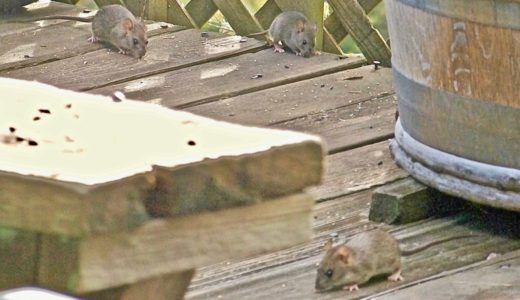
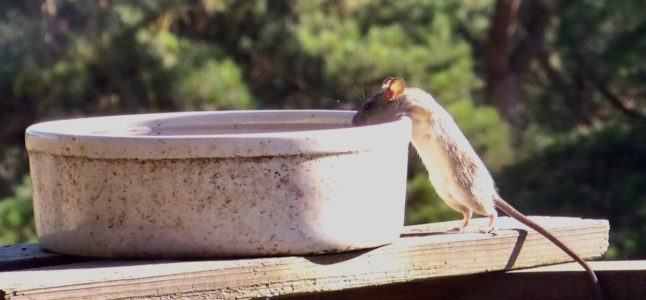
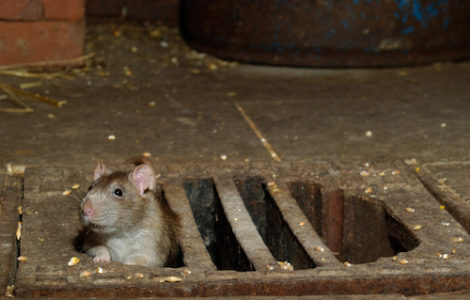
Because they count rats and mice among their numbers, rodents often get a bad rap from humans. Yet rodents are part of a food chain that supports many of West Marin’s most colorful carnivores. With that thought in mind, here’s a gallery of rodents found around my cabin.

A brush rabbit, also known as a cottontail, near my woodshed. Along with mice  — I’ve trapped a few but will spare you postmortem photos — rabbits have more predators than any other rodent-like creatures on this hill. (Scientifically speaking, rabbits are lagomorphs rather than rodents.)

They’re a main ingredient in fox diets. Hawks and owls eat them. So do bobcats and snakes, coyotes and cougars. Unfortunately for this hill’s rabbits, foxes and coyotes are becoming more common while a cougar has been seen more than once recently along nearby Tomasini Canyon Road.

Gophers, the bane of West Marin gardeners, in fact sustain a variety of predators. Having just caught a gopher outside my window, this bobcat — with the rodent in its jaws — trots off to dine. Also preying on gophers are creatures ranging from housecats, hawks and mountain lions to foxes and badgers.

A Sonoma chipmunk out my kitchen door. Also providing food for many of West Marin’s carnivores are chipmunks. Despite predation by bobcats, badgers, foxes, hawks and owls, chipmunks are rated a species of “least concern” on the Endangered Species List.

A roof rat eating birdseed on my deck. Roof rats can do damage — especially to dishwashers — when they get into a house. They’re prey for hawks and owls but less vulnerable to predators on the ground because the rats like to travel along branches, utility lines, and fence tops.

Roof rats originated in tropical Asia but spread through the Near East during the days of ancient Rome. They reached Europe by the 6th Century, and in the late 1340s, their fleas carried the bubonic plague that killed off half the population in some areas. Roof rats arrived in North America with the first ships to visit the New World.

A Western gray squirrel out my upstairs window. From what I can see, the main cause of gray squirrel mortality in West Marin is the motor vehicle. Their primary predators are red-tailed hawks, great horned owls, foxes, coyotes, dogs and cats.

So there you have it. Despite what the pest-control people say, having a few rodents around your house or rabbits around your garden makes for a healthy ecosystem. But guard your dishwasher.

The end of one year and the start of the next is traditionally a time for the news media to compile retrospectives, and this blog is no exception. Here are some of my favorite wildlife photos from the past all shot around my cabin in Point Reyes Station.

An increasing number of bobcats have been showing up on this hill during the past two years. I shot this photo through my kitchen window.

A mother badger (known as a “sow”), along with her cub (sometimes known as a “kit”), sunning herself last May on the mound of dirt around their burrow (known as a “sett”).

Adult badgers are remarkably efficient diggers thanks to long claws and short, strong legs.  Although they can run up to 17 or 18 mph for short distances, they generally hunt by digging fast enough to pursue rodents into their burrows.

Like skunks, badgers have perineal glands that emit quite a stench. What with the stench, the claws, and extremely strong jaws, adult badgers can hold their own against any potential attackers — including bears and coyotes — although they’d rather hide.

And speaking of coyotes, they too are becoming increasingly common on my hill. There were no coyotes in West Marin for 40 years, but when the federal government made sheep ranchers stop poisoning them, they began showing up here again in 1983.

In the last 25 years, they have put more than half the sheep ranches in West Marin and southern Sonoma County out of business. Of course, if you’re not a sheepman, it’s fun to see them and hear them yip and howl at night.

Raccoons are jolly neighbors unless they’re knocking over your garbage can or sneaking through your cat door. My cabin doesn’t have a cat door, and my garbage can is secured; however, when a mother and four kits were crossing my deck and found my kitchen door open, they walked right in.

Possums are not native to California but to the South. In his book The Natural History of the Point Reyes Peninsula, naturalist Jules Evens writes: “After the first known introduction into California at San Jose about 1900 (for meat, delicious with sweet potatoes), opossums spread rapidly southward.

“By 1931, they were common on the coastal slope from San Francisco Bay south to the Mexican border.” To the north, however, San Francisco Bay, along with the Sacramento and San Joaquin rivers, created a natural barrier, and they did not reach Point Reyes in any numbers until 1984, Evens notes.

Columbian blacktail deer. A young buck drowsily chews his cud outside my bedroom window.

A newly born fawn hides in tall grass less than a yard from my driveway. It remained motionless despite my standing overhead. Naturalist Evens speculated it probably thought it was invisible.

A wild turkey seen out my kitchen window. Like possums, wild turkeys are not native to California. In 1988, California’s Department of Fish and Game planted three toms and 11 hens for hunting at Loma Alta Ranch (on the ridge between Woodacre and Lucas Valley Road).

From there the turkeys spread to nearby Flander’s Ranch and the Spirit Rock property in Woodacre — and eventually to Nicasio, Olema, and even as far north as Tomales, where they have been known to intimidate small children and scratch the paint of cars on which they perch.

A Pacific gopher snake almost four feet long on Campolindo Road at the foot of my driveway.

“When disturbed, the gopher snake will rise to a striking position, flatten its head into a triangular shape, hiss loudly and shake its tail at the intruder,” the Arizona-Sonora Desert Museum reports. “These defensive behaviors, along with its body markings, frequently cause the gopher snake to be mistaken for a rattlesnake.”

The gopher snake is actually a constrictor, and it plays an important role in keeping my hill’s rodent population under control. However, it can also climb trees, and it will eat birds and eggs when the opportunity arises.

A garter snake on my driveway. Garter snakes are the most-common genus of reptile in North America. Although they are venomous, their venom is too mild to harm humans. However, when they’re disturbed, garter snakes emit a foul-smelling secretion from a gland near their anus.

An arboreal salamander beside my front steps. Cold-blooded animals require much less energy to survive than do warm-blooded animals. In fact, many cold-blooded animals try to keep their body temperatures low when food is scarce.

Pacific tree frogs, such as this one on my deck, depend largely on camouflage to escape predators. Notice how the facial stripe hides this frog’s eyeball. In addition, the frog’s color changes as it moves around. But unlike the chameleon, which changes its color to match background colors, the Pacific tree frog’s color depends on how moist or dry its location is.

A buckeye moth atop a chrysanthemum blooming on my deck. Probably it’s just my zen-like psyche, but of all my nature photos, this is the one I like best.

From 1920 to 1991, The New York Daily News called itself “New York’s Picture Paper” because it used photographs with captions rather than articles to report a disproportionate amount of the news.

In that spirit, this blog will now try out a Point Reyes Station Picture Posting.

snake

While carpenter Charlie Morgan was walking out my cabin’s basement door this morning, he spotted a small gopher snake slithering in. We grabbed it although it pretended it was a rattlesnake, flattening its head into a triangle and shaking its rattle-less tail. (Photo by Charlie Morgan)

The snake didn’t like being picked up and tried to wriggle free, but it didn’t strike. Its mouth was so small it probably couldn’t have even if it had wanted to. In any case, I soon released it.

100_2881_1

Seeva Cherms, daughter of Linda Sturdivant of Inverness Park, gave me this sign as a Christmas present two years ago.

As too many roadkills make evident, the possums of West Marin are in particular need of a safe preserve, so I’ve started one.

100_2828

A continuing problem, however, is the ancient feud between my hill’s possums and raccoons. Tense encounters occur night after night, and I’ve photographed several, such as this confrontation on Sept. 12.

100_2890_1

In an effort to end the inter-species unrest, I finally resorted to a two-millennia-old stratagem for keeping unruly masses complaisant. When anti-social disorder broke out again last night, I distracted the raccoon with bread and circuses — “panem et circenses” in the words of the Roman satirist Juvenal, who coined the phrase around 200 AD. The circus in those days was somewhat different, of course, although it did have lions.

barnum-animals

Tonight I tried the same ploy with the possum, and it worked until the raccoon came over and stole the bread. Raccoons are like that — even among themselves. I’m tempted to send one in particular to Father Flanagan’s Home for Wayward Raccoons in Kits Town, Nebraska.

Linda-and-BurtonMeanwhile over in Inverness tonight, Linda Petersen, the injured ad manager of The West Marin Citizen, showed up after a Volunteer Fire Department meeting to thank firefighter Burton Eubank (right).

Burton was the first rescue worker on the scene when Linda fell asleep at the wheel June 13 near Motel Inverness and hit a utility pole.

Linda suffered 18 broken bones and a punctured lung in the crash.

Burton tonight noted the dispatcher originally said the crash had occurred just west of downtown Inverness not far from Vladimir’s Czechoslovakian Restaurant. As he rushed to the scene from Inverness Park, however, Burton discovered the wreck was actually east of town and radioed other members of the volunteer fire department to let them know.

Linda remembers almost nothing from the wreck, so Burton recounted how he evaluated her condition and what he and other firefighters did to remove her from the car without causing further injuries. As it turned out, Linda had two broken vertebrae, so the precautions were crucial.

Burton obviously hadn’t learned how to do all this in one training session, I quipped. “I’ve been a firefighter 24 years,” he replied, “ever since I was 18.” Burton said that some of the VFD’s traffic-accident calls are grim but responses such as Linda’s help balance that.

And put it on your calendar that a benefit to help pay Linda’s medical bills will be held from 4 to 6 p.m. Sunday, Oct. 18, at Toby’s Feed Barn. There will be entertainment by Johnny and June from El Radio Fantastique, Peter Asmus and Space Debris, and Matt Love’s band (sometimes called the Love Field Allstars). The initial, so to speak, entertainer will be Charlie, the carpenter. Charlie, who’s also a DJ at KWMR, will be MC.

Providing food will be Marin Sun Farms, the Station House Café, Olema Farmhouse, Café Reyes, the Tomales Deli, the Palace Market, the Marshall Store, and Mike and Sally Gale’s Chileno Valley Ranch. In addition, Anastacio Gonzalez will barbecue oysters with his “Famous BBQ Oyster Sauce.” The sauce is now being bottled, with retail sales having begun last July.

Four years ago while I still published The Point Reyes Light, readers on their own gave birth to a new genre of first-person writing, Tall Tales of Intelligent Dogs.

The genre faded shortly before the grand old newspaper changed ownership, but the tales have now inspired me to try replicating with wildlife around my cabin what West Marin residents had reported accomplishing with their pets.

possum-with-placematGood table manners being a sine qua non for participating in polite society, last week I began teaching the local possum proper dining etiquette.

“I am teaching my dog to drive,” Ed Fielding of Bolinas wrote in a June 9, 2005, letter to the editor of The Light. “I am 81 years old, and my strength is ebbing, my reflexes are slowing, my vision is fading, and my hearing is deteriorating. The qualities I am losing my dog Juno possesses in superb degree. She is a 145-pound Rhodesian ridgeback – strong, quick, and very intelligent.

“I have made special metal cups and attached two of these to the steering wheel in the recommended ‘10-to-2’ position. The cups are well padded so that her front paws fit snugly, and she is able to steer the car with ease. I have also modified the accelerator and the brake pedal. With her long legs and great strength, she has no trouble operating these two mechanisms.”

It was an obvious spoof, but Fielding presented it with flair. “[Juno] just loves driving the car,” he wrote, “and the highlight of her day is when she gets behind the wheel and we go for a short spin. Of course, she drives with her head out the window, a habit I have been unable to break, but it seems to be no problem, and she handles the car with skill….

“If any readers of this letter have also taught their dogs to drive, I would appreciate hearing from you…”

The Light never heard from anyone else teaching his dog to drive, but the next issue carried a letter from David Miller of Inverness Park, who wrote, “I was pleased to learn from Ed Fielding’s letter that there are others who are training their pets to handle moving vehicles. In my case, I have been training my dog Bela to ride a bicycle.

“It all started when I would ride my bike and Bela would run on the path beside me on a leash. So many times I would hear angry people telling me I should get off the bike and let Bela ride that I decided that if I trained Bela to ride, we could mountain bike together and avoid the scorn of passersby…

“Bela is still on training wheels, and I have had to address a few mechanical problems. For example, I had to deal with her tail. It was always getting caught in the spokes of the back wheel. I solved that problem by tying a string to her tail and connecting it to her collar. I had to make sleeves on the handlebars into which she could comfortably slide her front legs for steering. Bela uses her mouth to manipulate the hand brake.”

Miller went on to say that his “real problem” is the policy of local parks to prohibit mountain bikes on certain trails and dogs on others, leaving Bela with few choices. This letter writer too asked to hear from others in his situation.

No other owners of canine mountain bikers responded, but Robin Bradford of Bolinas on June 30 wrote, “For quite some time, Frank and Winston, my Yorkshire Terriers, have tried to convince me to allow them free access to our Toro gasoline-powered lawn mower. Naturally, I refused….

“Recently, Frank and Winston brought me the letters to the editor from The Point Reyes Light written by Ed Fielding and David Miller. I can tell you, some fairly biting accusations were hurled… [and] I finally acquiesced.

“Much to my surprise, Frank and Winston operated the Toro as though they’d been doing it for years, which it turned out they had been. My teenage son had been taking the credit (and the allowance) for the job for an extended period of time, but it was actually Winston at the steering wheel and Frank running ahead to ensure straight lines on the grass…”

Through no effort on its part, The Light had suddenly become a weekly publisher of tall tales of canine cunning, all written in the form of letters to the editor.

Carl Dern of Stinson Beach on July 14, 2005, wrote, “I taught my dog Billie to weld. I realized that she had a great interest in welding when she was a pup because she would hang around my studio watching me weld. I made her a self-darkening helmet and a small leather apron so she wouldn’t hurt her eyes or burn her fur. As time went by, I noticed that she would try to nudge me away from what I was welding and try to take the welding torch from me.

“I soon caught on that she wanted to do the welding. I made her some small, padded cups for her paws to hold the welding gun. She worked the controls with her mouth and right-rear leg. I soon found myself holding the work while she welded it with beautiful precision and skill.

“Billie died last winter at the age of 16 and a half, which is 115 years human. I have not had the courage to disclose this information until now because I was afraid that I would be accused of exploitation. In my own defense, I paid Billie minimum wage and registered her as a Democrat. She voted for Kerry and missed Clinton very much. Our grandchildren inherited her estate.”

raccoon-bartenderBack in 2007, I myself taught a local raccoon to tend bar. Before long it could mix a margarita, Manhattan, or martini as fast as it could shake a tail. When government began enforcing a ban on smoking in bars, however, the raccoon quit to take an outdoor job.

As the parade of talented-dog stories continued, I was amazed not merely by the phenomena itself but also by their wit. “I think too many exceptional canines have gone unrecognized because the fear of low-cost dog labor is so prevalent,” Cory Griffith of Bolinas wrote on July 28.

“My confession was especially hard to make before now because it would have cost me my job. More accurately, my dog Rona’s job. I used to work as a dishwasher and occasional cook in an unnamed Stinson restaurant…. Rona always liked to follow me around the kitchen and beg for treats.

“After we’d been together for a few years, something strange began to happen; I noticed she’d alert me with a bark whenever the water was about to boil. From there it was just a few months of practice until a dog who couldn’t crack an egg transformed into one who was putting a shrimp on the Barbie. She’d grab a whisk in her mouth, and a few hours later we’d have a beautiful cake with only a few dog hairs in the frosting.”

For the same edition, Hawk Weston of Bolinas sent in a photo of herself and her pug Scrunchie. While practicing her guitar, Weston wrote, she noticed that “Scrunchie was spending an inordinate amount of time watching my fingers – especially the left-hand chord positions…

“I decided to teach her to play folk music, figuring if I could play it, how hard could it be? Actually, it wasn’t hard at all, especially after she suggested that I lay the guitar flat on the floor so she could play it like a Dobro with a flat-pick held tightly between her tiny teeth. She also developed her signature ‘softer sound’ by brushing across the strings gently with her little tail.”

Other tales came in from Kent Goodwin of New York City, who wrote that his yellow lab Trapper had developed expertise in corporate management while living in Stinson Beach. Scott Leslie of Point Reyes Station, however, growled, “Enough already.” He suggested that all the tales of canine accomplishments indicated a dog had taken over the editor’s desk.

But virtually all other letters were in the style of one by Inverness resident Laura Brainard of Planned Feralhood (the humane program for reducing the number of stray cats). Brainard on Aug. 4 wrote she’d read the letters aloud to cats in the program’s shelter to give them “inspiration.” The cats, however, “were not impressed,” she noted.

Cats, in fact, were beginning to creep into coverage that had been limited to a dog’s world. Sandra Wallace of Inverness on July 28 wrote, “I do hope someone is making a collection of the letters recounting the accomplishments of these exceptional dogs. One of my dogs – the one that reads – is fascinated and inspired by these accounts. The cats, however, remain incredulous.”

I’d would have been incredulous about all this too had I not seen it myself. In fact, now that I’ve tried it myself, civilizing the animal world doesn’t seem that difficult.

Editor’s note: The readers’ letters were previously summarized in my Aug. 8, 2005, Sparsely Sage and Timely column in The Light. The possum-and-table-setting photo was shot Wednesday.

What sort of day was it? A day like all days, filled with those events that alter and illuminate our times. And you were there.” That was Walter Cronkite’s weekly signoff in the 1950s when he hosted TV docu-dramas, You Are There, which reenacted historic events.

Here in no particular order are some of the events that altered and illuminated the past week or so in West Marin. And now, thanks to the wonders of photography and the Internet, you were there.

possum-coon-on-rail

The little possum which almost every night drops by for a visit is often a bit intimidated by the larger raccoons which also show up. Last Wednesday the possum was particularly chagrined when a raccoon walked overhead on the railing of my deck en route to the birdbath.

linda-at-home2

A joyful Linda Petersen, the advertising manager of The West Marin Citizen, came home to Point Reyes Station Saturday after two and a half months of hospitalization.

Linda suffered 11 broken ribs, two broken vertebrae, two broken ankles, a broken leg, a broken kneecap, a broken arm, and a punctured lung when she fell asleep at the wheel June 13 and hit a utility pole in Inverness.

Linda’s left leg is still in a cast, and she continues to need a wheelchair to get around. However, she no longer wears casts on her right leg and left arm or the steel-and-carbon halo that had immobilized her head and neck for seven weeks.

Today she spent a few minutes in The Citizen office and expects to now spend a few hours at her desk most weekdays. Friends and West Marin Senior Services are providing her with meals until she can cook again.

loading-garbage1

Redwood Empire Disposal, which is franchised to pick up garbage throughout West Marin, this week held its “summer community cleanup.” It was a chance for us customers to stack up to 14 bags, boxes, or cans of bulky waste at curbside to be carted off.

On Campolindo Way, our friendly garbageman Víctor showed up today to haul away the neighborhood’s junk. I had just spent two days cleaning out the basement in preparation for his arrival. Every time the garbage company holds these infrequent events, I scramble to collect half-forgotten stuff I’m finally ready to get rid of.

garbage-truck

Here Víctor uses neighbors Skip and Renée Shannon’s recycling bin to hoist their junk into the garbage truck.

Like many West Marin residents, I spend several days each summer trimming trees and brush to make my property safer from wildfires, and here too my personal schedule is regulated by Redwood Empire Disposal’s schedule. The garbage company picks up yard waste only every other week. That invariably leads to a lot of limb lopping just before each pickup.

foggy-morning

Mornings have been foggy most days recently in West Marin with the fog (seen here over Inverness Ridge and along Papermill Creek) typically burning off before noon.

sunset

The view from my deck reminded me of the wildfires that have been burning elsewhere in California. But it was merely the sun setting behind a fog bank. Gracias a Dios por eso.

One of the joys of living in Point Reyes Station is the variety of wildlife that comes with it. To demonstrate my point here’s an assortment of photos from the past week.

100_2574

After living on this hill for more than 30 years, I saw chipmunks on my property for the first time Sunday.

I knew there were chipmunks in the area, for I’d seen them in the Point Reyes National Seashore, and Point Reyes Station naturalist Jules Evens writes about them in his Natural History of the Point Reyes Peninsula.

The species of chipmunks around here are Sonoma chipmunks. They can be found from San Francisco Bay to Siskiyou County. On the Endangered Species List, the Sonoma chipmunk is rated a species of “least concern.”

Various authorities suggest the name chipmunk comes from an Odawa or an Ojibwe word meaning red squirrel and may have originally been spelled in English as chitmunk. Others attribute the name to the noise they make, a chipping sound for an alarm with a harsher version for courtship.

The Sonoma chipmunk is a “common resident of open forests, chaparral, brushy clearings, and streamside thickets from sea level to 6,000 feet [in elevation],” the California Department of Fish and Game reports.

“They forage among small branches of bushes and on ground for acorns, fungi, and seeds of manzanita, ceanothus, and gooseberry.” The rodents, in turn, “may be preyed upon by long-tailed weasles, bobcats, badgers, gray foxes, and various hawks and owls.”

Sonoma chipmunks, Fish and Game notes, “breed from February to July [with] one litter per year of three to seven young.”

lower-pond

A key reason for the variety of wildlife on this hill are two stockponds where all manner of critters go for a drink. Sunday night, coyotes next to this pond entertained my neighbors and me with an extended chorus of yips and howls.

100_2589

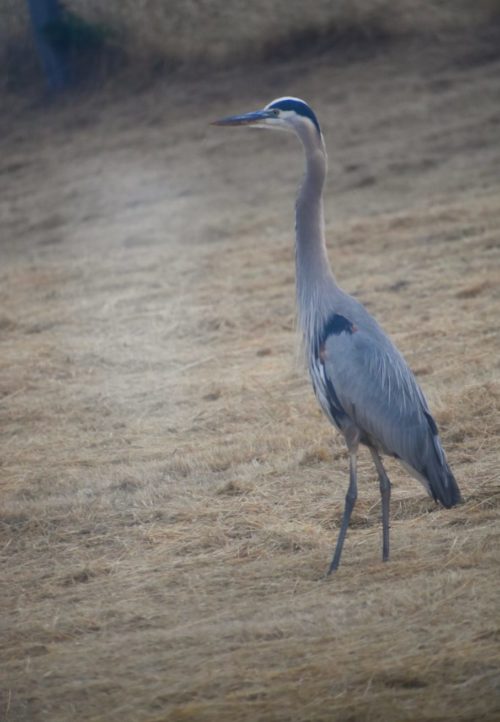
The ponds also attract Great blue herons (such as this one spotted Monday afternoon), along with egrets and ducks.

100_25721

Monday morning I looked up from making breakfast to find this young buck staring in the kitchen window at me.

100_2187

Raccoons are nightly visitors on my deck.

Their favorite food appears to be moths on my windows lured there by the light indoors. As happened last Wednesday, a raccoon will occasionally go to the effort of climbing onto my roof to pick moths off a dormer window.

turkeys1

Wild turkeys (seen here Monday) have become year-round residents on this hill.

The turkeys eat seeds, berries, acorns, and insects, along with small frogs and salamanders. Their hunting and pecking is often memorialized by pockmarked fields.

possum-closeup_1This young possum (seen Sunday) is a frequent visitor to my deck. He’s not fond of the raccoons, but he likes to drink from my birdbath.

Needing to get rid of some rancid peanuts a while back, I decided to leave them on my deck for whatever critter came along. Not realizing the possum was just outside my kitchen door, I opened it a crack and started to lay a handful down, only to have the possum suddenly emerge from the dark, stick its nose in my palm, and start nibbling on the nuts.

The possum made no attempt to bite me, but I quickly pulled my hand back lest I get nipped accidentally. It is rare for possums to carry rabies; their body temperature is too low, 94 to 97 degrees compared with 102.8 for raccoons and an average of 101 for domestic dogs. All the same, I highly recommend against hand feeding these cute little marsupials. You may have less luck than I did.

Next Page »