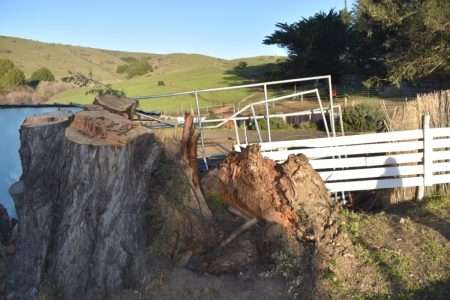
A sportscar went out of control on the Point Reyes-Petaluma Road immediately east of Highway 1 about 2:30 p.m. today, sailed off the roadway, and landed on its wheels 25 feet down an embankment.

The white Porsche GT-3, which landed facing back toward the road, was airborne for roughly 50 feet, as evidenced by bare spots where bark had been knocked off limbs high above the ground.

From skid marks on the pavement, it appears the driver lost control in rounding the first curve east of Point Reyes Station. He then over-corrected and ended up in the oncoming lane before spinning back across the road and off the embankment.

The driver, who declined to give me his name or hometown, was not injured in the wreck. (Monday morning update: the CHP has now identified the driver as Joshua Moore, 38, of San Rafael.)

Traveling with the Porsche when the wreck occurred was a red Ferrari, but its driver told me he didn’t know what caused the mishap. (The CHP on Monday said the accident was caused by an “unsafe turning movement” but that Moore had not been cited.)

The property on which the Porsche landed is used by Tomales Bay Oyster Company, and its workers managed to turn the car around by sliding it on the muddy ground.

The driver was able to start his car only to have its wheels spin in the mud. The oyster workers then pushed the car to open ground, from which it could be towed.

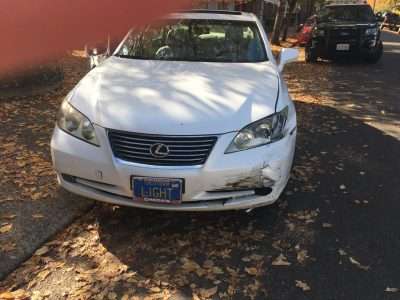
A highway patrolman checks the car while the driver stashes its broken spoiler behind the seats.

Because the driver declined to identify himself (and because it took three days to get the information from authorities), all I initially knew about him is what’s on his license plate frame: “Member 11-99 Foundation.”

The name “11-99″ is taken from a radio-code message that means: “Officer needs assistance. Send location to all units.” The foundation, according to its charter, “provides emergency, death, and scholarship benefits to California Highway Patrol family members.”

To aid the families of retired officers and those killed in the line of duty, the foundation raises its money from individual donors, volunteers, and grant-making institutions.

However, the “member” license-plate frames have occasionally come under fire as potentially having a corrupting effect. Critics in past years claimed that people who liked to drive fast made large donations in order to get the frames, a membership certificate, and a special wallet with a 11-99 Foundation badge to show any CHP officer who pulled them over.

The 11-99 Foundation directors voted to phase out the frames last year and to more aggressively prevent people from selling them online. The directors also instructed staff to “develop a program to address the status of all ‘Member’ license-plate frames currently in circulation.”

The foundation on its website says it needs to maintain control over the frames because “we don’t want the 11-99 Foundation to continue to suffer because some misguided individual tried to take advantage of the license-plate frames, hoping they would inappropriately influence a law enforcement officer.”

Past postings are numbered in the order they went online, with the most recent postings located immediately below the Table of Contents.

To go directly to stories without scrolling, click on the highlighted phrases following the numbers.

Weekly postings are published by Thursday.

231. A chat with the Trailside Killer

230. Life and death on my hill

229. Valentine’s Fair raises money for Haiti relief

228. Historic irony as milk truck overturns in Marshall

227. Encouraging my bodhisattva possum on her path to enlightenment

226. Benefit for Haitian earthquake survivors filled with mixed emotions

225. What drought? Nicasio Reservoir overflows

224. Disconcerting standup reporting

223. The storms begin; schools close; a near miss at my cabin

222. Spare the rodent (or rabbit) & spoil the diet

221. Lookin’ out my backdoor: some of my favorite wildlife photos

220. Careening through the holidays

219. Chileno Valley journalist working in Abu Dhabi brings new wife home for visit

218. Just what would Mayberry be like on acid?

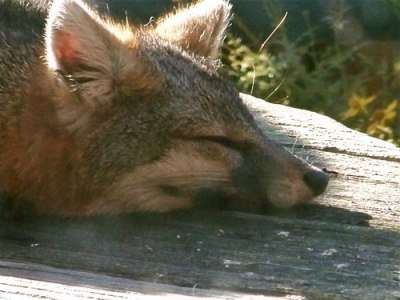
217. The foxes of downtown Point Reyes Station

216. Interpreting dreams

215. Let’s talk turkey

214. You’ll Never Walk Alone — an unlikely story

213. A wistful walk on the bottom of Nicasio Reservoir

212. Progress in the backyard peace process

211. John Francis leaving; 4 other artists turn pages but sticking around

210. What we inherit

209. Over 200 show up at fundraiser to help pay injured ad manager’s medical bills

208. A community helping one of its own

207. A country mouse in the Tenderloin

206. News of the week reported through pictures

205. Update on injured ad manager of West Marin Citizen; benefit planned; and will there be a race?

204. Startling weather; amazing stepdaughters

203. Talented-animal tales

2o2. Saga of The West Marin Citizen ad manager’s recovery spreads around the globe — not always accurately

201. And you were there

200. Hospitalized ad manager of West Marin Citizen coming home; friends volunteering to provide meals

199. Scenes from the Inverness Fair

198. Great progress for injured ad manager of The West Marin Citizen despite problems with convalescent hospital

197. Thieves use ruse to clean out till at Station House Gifts

196. Anastacio’s Famous BBQ Oyster Sauce goes on sale

195. A hillside of wildlife

194. Kaiser Permanente’s ‘Sicko’ machinations shock injured ad manager of The West Marin Citizen

193. Immobilized by multiple injuries, ad manager keeps selling from hospital bed

192. All creatures feathered and furry

191. The wildlife of summer around my cabin & an update on Linda Petersen’s condition 

19o. West Marin Citizen advertising manager hurt in crash; her popular dog Sebastian dies

189. Sunday’s Western Weekend Parade

188. The Western Weekend Livestock Show

187. Western Weekend parade will be Sunday despite reports to the contrary

186. The purple couch beside the road

185. A funny thing happened at the car wash Friday & other odd events

184. My brush with a badger

183. Scientists find no evidence oyster farm harming Drakes Estero; more likely restoring it

182. Why bottom of Drakes Estero can never become part of a wilderness area

181. Badger, Ratty, and the sensual raccoon

180. ‘And how the wind doth ramm!/ Sing: Goddamm — Ezra Pound

179. A tailgate gallery of bumper-sticker humor; Point Reyes weather both Arctic & tropical

178. Crowd in Inverness Friday calls for reviving park’s Citizens Advisory Commission

177. Flying over Northwest Marin

176. Spring meditations in a Miwok cemetery concerning the news of West Marin.

175. Two warning signs of Spring

174. Tomales may be little but it’s lively

173. Doe stalks cat; raccoon emulates Scripture — for the rain it raineth every day

172. Three-year drought comes to a symbolic ending as Nicasio Reservoir overflows

171. Pot busts at my cabin — again

170. Happy Valentine’s Day (as it’s evolved)

169. Blogging about blogging

168. Thinking about words

167. Point Reyes Station celebrates President Barack Obama’s inauguration

166. A reader in Ghana

165. The bittersweet story of a hardy little tree

164. A parting look at 2008

163. Blackout hits Tomales Bay area

162. Nature’s Two Acres Part XXXVIII: Way Out West in West Marin

161. Chileno Valley Ranch as depicted by a rancher-artist who lives there

160. Nature’s Two Acres XXXVIII: This time it’s a tale of two bobbed cats

159. Thanksgiving in Point Reyes Station

158. Nature’s Two Acres Part XXXVII: a bobcat at my cabin

157. Quotes Worth Saving II

156. Nature’s Two Acres Part XXXVI: The migrating birds of fall; or ‘Swan Lake’ revisited

155. Election night euphoria

154. The fun and anxiety of preparing for a disaster

153.  Porky Pig, Demosthenes, Joe Biden, and ‘K-K-K-Katy

152. The political zoo.

151. Nature’s Two Acres Part XXXV: Mr. Squirrel

150. A coyote at my cabin

149. Preparing for the fire season

148. Telling the Raccoon ‘Scat’

147. Faces from the weekly press

146. Tomales, Tomales, that toddling town

145. How park administration used deception & sometimes-unwitting environmentalists to harass oyster company with bad publicity

144. Nature’s Two Acres Part XXXIII: Photographing wildlife indoors and out

143. What government scientists elsewhere had to say about the park’s misrepresenting research to attack oyster company

142. Landscape photos & paintings in Stinson Beach

141. What’s in the Inspector General’s report on the park that newspapers here aren’t telling you

140. Point Reyes National Seashore Supt. Don Neubacher seen as ’scary’

139. A demonstration to save Point Reyes National Seashore deer; park administration dishonesty officially confirmed

138. The good, the bizarre, and the ugly

138. Alice in ‘Wilderness

137. Nature’s Two Acres Part XXXII: The first raccoon kits of summer

136. Nature’s Two Acres Part XXXI: The pink roses of Point Reyes Station

135. Nature’s Two Acres Part XXX: Baldfaced hornets

134. Scenes from my past week

133. Artist Bruce Lauritzen of Point Reyes Station draws a crowd for opening of exhibit

132. Kite day at Nicasio School

131. Sunday’s Western Weekend Parade in photos

130. Early projections hold: Obama, Woolsey & Kinsey win… Leno easily bests Migden & Nation

129. Western Weekend’s 4-H Livestock Show fun — but smaller than ever

128. Humane Society of the US says National Seashore claims about deer contraception are misleading

127. Lt. Governor John Garamendi joins battle to save fallow & axis deer in Point Reyes National Seashore

126. Nature’s Two Acres Part XXIX: Cold-blooded carnality… Or, why be warm blooded?

125. Nature’s Two Acres XXVIII: The first fawns of spring

124. The Beat Generation lives on at the No Name Bar

123. ‘Still Life with Raccoon

122. Nature’s Two Acres XXVII: Animals about town.

121. Newspaperman from Chileno Valley describes his life in the United Arab Emirates

120. Point Reyes Station and Inverness Park demonstrators call for a pedestrian bridge over Papermill Creek

119. Seeing history through newsmen’s eyes…. or the pen is mightier than the pigs

118. Five Faces of Spring

117. Supervisor Steve Kinsey defends further restrictions on woodstoves in West Marin

116. Prostitution in New York, Reno, and Point Reyes Station

115. A country without the decency to ban torture

114. National Seashore’s slaughter of deer traumatizes many residents here; ‘we demand a stop’

113. A tale of Kosovo, West Marin, and a bored battalion of Norwegian soldiers

112. Dillon Beach sewage spill update

111. ‘Drive-by journalism’

110. Sewage spills into ocean at Dillon Beach

109. Nature’s Two Acres XXVI: Which came first, blacktail or mule deer? Hint — their venison is oedipal

108. Nature’s Two Acres XXV: Talking turkey

107. Here’s hoping ‘the goose hangs high this Thursday for Valentine’s Day

106. Signs of bureaucratic contamination

105. A final thought about the Caltrans worker who just did his job — and saved the day

104. Statewide campaign to legalize hemp and marijuana comes to Point Reyes Station

103. Heavy news media presence briefly halts axis-deer slaughterin the Point Reyes National Seashore

102. Storm damage bad but could have been tragic

101. Nature’s Two Acres XXIV: Buffleheads, Greater Scaups, and the 16.6 million wild ducks shot annually

100. Lawsuits against and by Robert Plotkin settled out of court

99. Nature’s Two Acres XXIII: Bambi, Thumper, and Garfield

98. Governor Schwarzenegger’s proposal to close Tomales Bay State Park to save money could prove expensive

97. Old Christmas trees, wild turkeys, and the famous cat-and-rat scheme

96. Blackouts, newspapers in the news, and poetic frustration on the prairie

95. Hurricane-force wind & heavy rain take heavy toll on West Marin

94. Marin County gets a bum rap from itself

93. ‘Eco-fascism in the Point Reyes National Seashore

92. Guess who came to Christmas dinner

91. Yuletide greetings from Santa Claws

90. Assemblyman Jared Huffman’s ominous mailer

89. Nature’s Two Acres XXII: They’re hundreds of times more deadly than cynanide… and headed this way

88. Non-native species stops traffic in Point Reyes Station

87. Blackouts bedevil Point Reyes Station area

86. Urban legends

85. Nature’s Two Acres XXI: Coyote influx benefits some birds around Point Reyes Station

84. Winter Moon Fireside Tales — an undiscovered gem draws only four ticketholders opening night (but more for second show)

83. Striptease in Point Reyes Station… well, sorta

82. Our Lady of the Chutzpah — the many faces of State Senator Carole Migden

81. Stefanie Pisarczyk (AKA Stefanie Keys): a woman of two worlds

80. Point Reyes Station’s ‘Path of Lights’

79. Lessons to be learned from the oil spill

78. Nature’s Two Acres Part XX: Where coyotes howl and raccoons roam free

77. West Marin Community Thanksgiving Dinner celebrated in Point Reyes Station’s Dance Palace

76. Giving thanks for an abundant harvest

75. Being a Gypsy isn’t enough; KPFA fires host criticized for not being a ‘person of color’

74. Nature’s Two Acres Part IXX: ‘Things that go bump in the night’

73. Point Reyes Station pharmacist decries health-insurance practices

72. Farm Bureau president quits; defends independence of wife who disagrees with his political position

71. Ship hits Bay Bridge; spilled oil drifts out Golden Gate and mires birds on West Marin coast

70. California photo book’s release celebrated with gala on Inverness Ridge

69. Coastal Post’s December issue to be its last, assistant editor says; publisher contradicts her

68. West Marin’s ‘Mac Guru’ leaving town — a friend with a knack for surviving

67. One last warm weekend before the season of darkness

66. Ranching matriarch Hazel Martinelli dies at 101

65. Nature’s Two Acres Part XVIII: Seasonal sightings

64. White House Pool: a public park where management listens to the public

63. Tuesday’s Marin County Farm Bureau luncheon for politicos

62. Hawks on the move

61. Point Reyes Station’s Hazel Martinelli celebrates 101st birthday with party at son’s deer camp

60. Vandals dump sewage at West Marin School

59. Paving Point Reyes Station’s main street at night

58. Bolinas firehouse and clinic opening party Sunday

57. Nature’s Two Acres XVII: As seen by an old, almost-blind dog

56. Despite public-be-damned management, it’s still a beautiful park.

55. Language, politics & wildlife

54. Truth becomes an endangered species at the Point Reyes National Seashore.

53. ‘Possums,’ a sequel to the musical ‘Cats’

52. The KWMR/Love Field ‘Far West Fest’

51. Quotes Worth Saving & the Inverness Fair

50. Watching the Point Reyes National Seashore obliterate cultural history

49. Congress sees through Point Reyes National Seashore claims

48. Music, wildlife, and the cosmos

42. Garbage in, garbage out

41. 76-year-old Nick’s Cove reopens

40. What we didn’t celebrate on the Fourth of July

39. Ship’s flare or meteor

38. The death of a salesman: Andrew Schultz

37. Preventing fires at home while The Point Reyes Light feels the heat

36. Monday’s demonstration against The Point Reyes Light

35. Inverness Park fire Friday razes art studio

34. Western Weekend retrospective; anonymous satire of Point Reyes Light distributed at parade; Light’s use of unpaid interns may run afoul of labor laws.

33. Sunday’s Western Weekend parade and barbecue

32. Many fail to find Western Weekend livestock show; a new newpaper debuts in West Marin; The Point Reyes Light reports a former bookkeeper is in jail on embezzlement charges.

31. Nature’s Two Acres Part XVI: A gopher snake & other neighbors

30. New newspaper to be published in West Marin

29. Mermaids, cows, Horizon Cable, and Russia’s Internet war on Estonia

28. Nature’s Two Acres Part XV: ‘Among animals…one finds natural caricatures.’

27. Nature’s Two Acres Part XIV: ‘The world, dear Agnes, is a strange affair.’

26. Sheriff Bob Doyle ’stays the course’ despite blunder and gets county government sued.

25. Nature’s Two Acres Part XIII: ‘Who’s the Head Bull-Goose Loony Around Here?’

24. Nature’s Two Acres Part XII: April showers ‘cruel’ with ‘no regrets’

23. Nature’s Two Acres Part XI: The perky possum

22. Former Point Reyes Light columnist John Grissim, the late pornographer Artie Mitchell, Brazilian President Lula and the advent of orgasmic diplomacy

21. Nature’s Two Acres Part X: ‘Nature Red in Tooth and Claw’

20. Nature’s Two Acres Part IX: Point Reyes Station’s blackbirds

19. Nature’s Two Acres Part VIII: ‘Mice & rats, and such small deer’

18. The Gossip Columnist

17. Saying Yes to Change: A former Point Reyes Station innkeeper finds true joy by moving in with a working-class family in a poor neighborhood of San Miguel de Allende, Mexico.

16. The Bush Administration at Point Reyes Part II: Whatever happened to the Citizens Advisory Commission to the GGNRA & Point Reyes National Seashore?

15. The Bush Administration at Point Reyes: Part I

14. Marin supervisors refuse to tilt at McEvoy windmill

13. Nature’s Two Acres Part VII: Rats v. dishwashers

12. Nature’s Two Acres Part VI: How Flashing Affects Wildlife

11. Nature’s Two Acres Part V: By Means of Water

10. Bankruptcy court trustee lets Robert Plotkin hold onto some of his Ponzi-scheme ‘profits’

9. Big Pot Busts at My Cabin

8. Storm-caused fire razes Manka’s Lodge and Restaurant in Inverness

7. Nature’s Two Acres Part IV: Christmas turkeys & where the buck stopped

6. Nature’s Two Acres Part III: Insectivores and Not

5. My background: Biographical information on newspaperman Dave Mitchell

4. Nature’s Two Acres Part II: Living dinosaurs actually found around my cabin

3. Nature’s Two Acres: A Point Reyes Station Photo Exhibit

2. Robert I. Plokin and Lys Plotkin

1. Introduction to this site SparselySageAndTimely.com plus an account of orphaned fawns being released in Chileno Valley.

In 1979-80, “Trailside Killer” David Carpenter murdered one woman and possibly three others on Mount Tamalpais, as well as three women and a man in the Point Reyes National Seashore. Most of the women were also raped.

Carpenter’s arrest came the following year after he murdered two women in Santa Cruz County. He was caught when the companion of one Santa Cruz victim survived despite being wounded and was able to give lawmen a description of the assailant.

For years, Carpenter has also been a suspect in several other slayings, and this week San Francisco police announced DNA evidence has now tied him to the 1979 murder of Mary Frances Bennett, 23, of San Francisco. She had apparently been jogging near the Palace of the Legion of Honor when attacked.

Police said she had been stabbed at least 25 times in her chest, back, and neck. Bennett’s “butchered” corpse was found under a thin layer of dirt and leaves.

In 1984, a jury in San Diego County convicted Carpenter of the Santa Cruz murders, and he was sentenced to be executed. In 1988, a second jury convicted him of the National Seashore murders and one murder on Mount Tamalpais.

After he was placed on death row in San Quentin where he remains today, Carpenter (left) contacted me out of the blue, and this ultimately led to my interviewing him in the prison. Photo by Christopher Springmann

At the time of the interview in 1985, Carpenter, then 55, had spent more than 22 years in custody.

Carpenter was first incarcerated at the age of 17 for allegedly having oral sex with a three-year-old girl. He denied the charge but spent three months in Napa State Hospital.

Three years later — in 1950 — he was arrested on charges of raping a 17-year-old girl, but the charges were dropped. Ten years later, he was arrested a third time. A military policeman shot and wounded Carpenter when the officer found him using a hammer to beat a secretary who had rebuffed his sexual advances. He went to federal prison for nine years.

In 1969, ten months after his release, Carpenter sexually attacked two women in Santa Cruz County, stole a car, and drove to the Sierra. In Calaveras County, he robbed two women, kidnapping one of them. He would later be charged with rape in connection with the Calaveras attacks, but that charge was eventually dropped.

A few days after the Calaveras attacks, Carpenter was arrested in Modesto. Convicted of robbery and kidnapping in Calaveras County (where he escaped from jail briefly) and of rape in Santa Cruz County, Carpenter went to state prison for seven years.

When he got out in 1977, he was returned to federal prison for violating his parole with the Calaveras and Santa Cruz attacks. In 1979, Carpenter was placed in a halfway house in San Francisco while awaiting parole. Three months later, the first trailside murder occurred. Here are the murders to which he had been previously linked:

• Edda Kane, 44, of Mill Valley was shot in the back of the head Aug. 19, 1979, while hiking on Mount Tamalpais.

• Barbara Schwartz, 23, of Mill Valley was stabbed to death while hiking on Mount Tamalpais March 8, 1980.

• Anna Mejivas, a friend of Carpenter, was found slain in Mount Tamalpais State Park on June 4, 1980.

• Cynthia Moreland, 18, of Cotati and Richard Stowers, 19, of Two Rock were shot to death Oct. 11, 1980, off Sky Trail in the National Seashore.

• Anne Alderson, 26, of San Rafael was jogging at the edge of Mount Tamalpais State Park Oct. 15, 1980, when she was killed with three bullets to the head. Alderson’s murder was the only one on Mount Tamalpais for which Carpenter was prosecuted.

• Diana O’Connell, 22, of Queens, N.Y., and Shauna May, 23, of Pullman, Wash., were shot to death Nov. 28, 1980, also off Sky Trail in the park. Their bodies, along with those of Moreland and Stowers, were found the following day.

• Ellen Hansen, 20, a UC Davis graduate student, was shot to death while hiking near Santa Cruz March 29, 1981. Her companion, Steven Haertle, was shot four times but survived.

• Heather Skaggs, 20, of San Jose disappeared the day she was scheduled to go shopping with Carpenter, May 2, 1981. Her body with one gunshot wound to the head was found in Santa Cruz May 24.

As it happened, KQED television in 1985 taped a debate between Synanon attorney Phil Bourdette and me. After watching the debate from inside San Quentin, Carpenter wrote me at The Point Reyes Light, and we began a correspondence.

Before it ended, Carpenter was answering questions from The Light and its readers. How common is homosexual rape of inmates by inmates? Most rapes occur in large jails operated by counties, not in state prisons, Carpenter answered.

With so much money being spent on prisons, how well is it used? “Pre-1976-77, everybody was under an indeterminate sentence, and you had to earn your way out of prison,” Carpenter replied. “There was very little trouble in the prison system  because the men knew they had to keep their noses clean to have any chance at parole.

“Back then most of the work that was done in prison was done by the inmates themselves. Rehabilitation is dead in this state….. Virtually all of the jobs that were done by the prisoners and cost the taxpayers practically nothing are now all being done by civilian personnel at a very high cost to taxpayers.”

When I managed to schedule an interview with Carpenter in San Quentin, I was intrigued by the prospect but didn’t know what to expect. Would he seem to be a monster, a sadist? Carpenter instead seemed rather charming.

While admitting “my record sucks,” Carpenter stammered that he was not responsible for the trailside murders. Carpenter’s stuttering was, in fact, so severe I felt an immediate sympathy.

Carpenter acknowledged experimenting with pot after he got out of prison in 1979, so I asked if marijuana gave him any relief from his stuttering. “Alas,” he replied, “it really didn’t do anything for me speechwise. My stuttering stayed the same, but my attitude toward my stuttering changed. The more I smoked, the less I cared or let it bother me.”

Years later in conversation with a former member of the San Quentin staff, I speculated that Carpenter’s stuttering was so disarming it may have made sympathetic women more vulnerable to an attack.

The former staffer, in turn, said he suspected that Carpenter murdered his rape victims because a middle-aged, bald man with an extreme stutter would be easy to identify. That does make sense.

For the last three or so years, a feral cat has been hanging out on this part of the hill.

At first I wasn’t pleased to have him on the hill, fearing he would try to catch the birds around my cabin. My neighbors Dan and Mary Huntsman weren’t particularly happy to have the cat around either because it used to fight with their cats.

Over time, however, the cat began to fit into the neighborhood better, and the deer that also hang out on this hill were intrigued by it.

A doe watches the cat wash itself.

On Valentine’s Day, however, I noticed the cat lying in the grass outside my kitchen window. It was so motionless I thought it might be dead, but eventually it got up, shook itself, and walked off.

The next morning I was a bit surprised to see a buzzard sitting in a tree outside my living-room window. I had never seen a buzzard in the tree before. After looking around for a while, the buzzard flew off, but the following morning, it was back. Only this time it was on the ground eating the cat.

Not only was the scene disturbing, I found myself wondering what killed the cat. If the cat died as a result of eating a mouse or rat that had been poisoned, the buzzard could be poisoned too. The buzzard soon flew off, and I put the remains of the cat in the garbage to eliminate any further risk to buzzards.

However, as my friend Tony Ragona pointed out later in the day, cats die for many reasons, and for all I knew this one may well have died from kidney failure.

That made me feel a little better for the buzzard, but I still felt a bit shocked at having seen a housecat — albeit one that had gone feral — being eaten by a buzzard outside my window.

The cat’s grim departure seemed one more reason to periodically put your spare change in the Planned Feralhood cans on the checkout counters of several stores in Point Reyes Station.

The program is headed by Kathy Runnion of Nicasio, who works at the Point Reyes Station Post Office, and it has been successful at humanely limiting the number of feral cats around town.

Another surprise: Last week I was in my loft one midnight dreary while I pondered weak and weary over many a quaint and curious posting of forgotten lingo when suddenly there came a tapping, as of someone gently rapping, rapping at my dormer window.

“Who could my visitor be?” I muttered. “Wind or prophet? Bird or devil? A raven on the window’s bevel?”

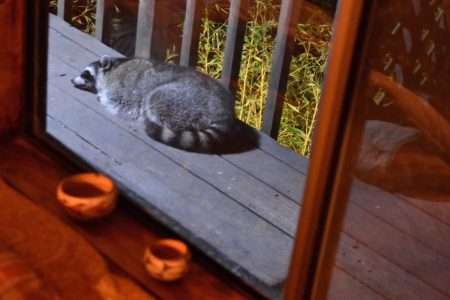
But ’twas no raven tapping on my dormer window. Two raccoons had climbed onto the eaves above my front door and were hunting moths attracted to the light coming through the glass.

When I used to cover Sheriff’s Calls for The Point Reyes Light, I’d periodically come across a dispatcher’s report that some resident home alone at night was alarmed at hearing a prowler outside the house, sometimes on the roof. Inevitably a deputy would investigate, find no prowler, and conclude the culprit must have been a raccoon.

The answer may not have satisfied the resident, but from what I’ve observed, most of the time it was probably correct.

A Valentine’s Fair Saturday at Toby’s Feed Barn was the latest fundraiser hereabouts to help survivors of the catastrophic earthquake that hit Haiti a month ago.

The small-scale fundraiser, which coincided with a “mini” farmers’ market, brought in several hundred dollars. Joyce Goldfield (at right) of Inverness Park sold more than $200 worth of anatomically correct gingerbread men and women.

Linda Petersen, ad manager for The West Marin Citizen, organized the fundraiser and sold $58 worth of Valentine’s cards made by second grade students at West Marin School.

In June, Linda was severely injured in a traffic accident, which killed her popular Havanese dog Sebastian. Four months ago, another fundraiser was held at Toby’s to help pay her medical bills, and last month she found a new Havanese, Eli (pictured), at the Marin Humane Society.

Other contributors to Saturday’s fundraiser were Moonflowers Bodycare (soaps and lotions), Sandra Wikholm, who sells baked goods at Wedgewood Bakery, Gaia Tea, Marin Roots Farm, Flower Power, rancher Liz Daniels, KT’s Kitchen catering, Zuma, and the Giammona brothers, Morgan and Ryan, (eggs).

Their mother Connie Giammona brought an orphan calf for a petting zoo while Kathy Simmons, wife of West Marin Citizen publisher Joel Hack, brought rabbits to be petted. The singing duo Todd Pickering & Blue performed, as did flamenco guitarist Carl Nagin.

Myriam and Mark Pasternak of Devil’s Gulch Ranch in Nicasio were in Haiti during the earthquake and told about their experiences. Myriam had previously founded a nonprofit, DG Educational Services, which teaches Haitians how to raise and breed rabbits for food. Part of the proceeds will go to the project, and part will go to Partners in Health run by Dr. Paul Farmer.

Sponsoring Saturday’s fundraiser were Toby’s Feed Barn and The West Marin Citizen.

A loaded milk truck belonging to Straus Family Creamery of Marshall overturned along Highway 1 just north of Nicks Cove today. The Highway Patrol reported the accident happened at 8:50 a.m.

The 270-degree rollover occurred when the long tanker-truck, which was southbound, encountered a northbound vehicle on a tight curve, members of the county fire department and Straus family told me. The truck came to a stop with a pair of its dual rear wheels off the pavement, the firefighter said.

The truck was still upright when the driver got out, but it then rolled over, the firefighter added. No one was hurt in the accident.

The property on which the truck landed is part of the Golden Gate National Recreation Area, and a small amount of milk spilled out of the tanker’s hatch.

In a serendipitous irony, however, the spilled milk didn’t go very far, let alone down to Tomales Bay a short distance below the curve.

Straus Creamery uses rice hulls for bedding in the cows’ stalls, and in 2003, a truck heading to the dairy ranch ran off the same curve and spilled a load of hulls. The decision at the time was to leave the hulls on the ground since they weren’t doing any harm.

When milk began leaking from the overturned tanker-truck today, it was immediately absorbed by the old rice hulls. Here a cleanup worker shovels more hulls under the leak.

As mentor to a female possum on my hill, I have been helping her find greater tranquility in life. Before we proceed with the story, however, here’s a quick summary of events up to now.

The first challenge was to overcome hostility between the possum and a raccoon that also likes to hang out around my cabin.

To do this, I brought them to the negotiating table by putting two handfuls of peanuts on it. Over the course of several nights, I moved the handfuls closer and closer together until they were contentedly eating nose to nose.

My next challenge was to teach the possum proper dining etiquette. That proved fairly easy.

This being Marin County, I’ve now begun encouraging Ms. Possum to become a bodhisattva and begin the path toward spiritual enlightenment. Fortunately, her curiosity has been piqued, and she’s giving it a try.

Resting from her sojourn, the bodhisattva achieves serenity among life’s blossoms.

Many possums never find tranquility. Here a male possum turns his head to show one of several bites he recently received from somebody — presumably another male.

As it happened, Linda Petersen, ad manager of The West Marin Citizen, and I were watching last week when he began making moves on Ms. Possum. At first she ignored him, but when he persisted, she hissed and bared her fangs, causing him to back off.

Although noticeably larger than Ms. Possum, the male is scared of me and skedaddles whenever I open a door onto my deck.

Ms. Possum and I, on the other hand, get along famously. She’s grateful for any peanuts I put out and has no problem with my petting her, as one would a dog, or scratching her behind the ears. Photo by Linda Petersen

From scratching her, I’ve seen for myself what excellent insulation Ms. Possum’s outer layer of fur provides. Even on cold, wet nights, her soft, inner lay remains warm and dry.

However, I should stress that Ms. Possum is unusual and that you shouldn’t try this at home. There were no possums to speak of in West Marin until 25 years ago (they’re native to the Deep South), so you wouldn’t be screwing up an established ecosystem by befriending one. But possums have sharp teeth, and you don’t want to end up like the male above with a bunch of puncture wounds.

The danger is not primarily rabies. The body temperature of possums is low enough they seldom get it. Nonetheless, they can carry H1N1 (swine flu), and I always wash my hands after petting with Ms. Possum.

A fundraiser at Cavallo Point Sunday for Haiti’s earthquake victims brought in $15,345. The restaurant and lodge are at Fort Baker in Sausalito, and 120 attendees from East and West Marin filled a second-floor dining room to capacity.

The magnitude 7 earthquake that struck Haiti Jan. 12 was, as most of us realize, a disaster beyond comprehension. Virtually every multi-story building around the capital Port-au-Prince collapsed, and an estimated 200,000 people died. (By way of contrast, Hurricane Katrina, the worse natural disaster in US history, claimed 1,800 lives.)

So many hospitals fell down that the few remaining have been overwhelmed by thousands of seriously injured survivors. Food and water are scarce throughout much of the country. Public utilities and government facilities are in ruins.

All the money raised Sunday is going to two nonprofits, Partners in Health run by Dr. Paul Farmer and DG Educational Services Haiti project founded by Myriam Kaplan Pasternak of Nicasio.

Kevin and Nancy Lunny of Drakes Bay Oyster Company contributed oysters on the half shell to the fundraiser.

Myriam’s project teaches Haitians how to raise and breed rabbits for food, and she and her family happened to be in Haiti when the earthquake struck.

Luckily they were riding on a rural road. If they had been in the school where they were headed, they might well have died because the school collapsed, as can be seen in this photo by Myriam. Some students in the school were killed, she noted during the fundraiser.

Part of the West Marin contingent, Kay McMahon and Jim Campe of Inverness, chat before the dinner.

Myriam on Sunday told the gathering about the immediate aftermath of the quake, as well as about the days that followed.

The scenes on television of desperate Haitians in Port-au-Prince struggling with each other for food and water were not typical of the nation, she said.

In much of the country, the disaster brought people together.

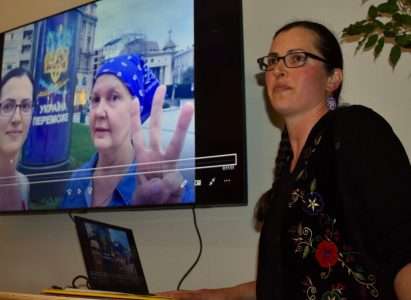
How Sunday’s event came to be is a story in itself. It was the brainchild of reporter Andrea Blum, who worked for me at The Point Reyes Light six years ago and now reports for The West Marin Citizen.

Only two weeks earlier, she had decided to hold a Haitian fundraiser at the Muir Beach Community Center.

Andrea invited Myriam and her husband Mark Pasternak to attend, and Mark (right) used the Internet to encourage others to take part.

When Cavallo Point chef Joseph Humphrey received word of the fundraiser, he volunteered to host a larger event and provide food, a dining room, cooks, and formal serving staff.

Cavallo Point’s restaurant, by the way, is the only Michelin-rated restaurant in Marin County, and Sunday night’s elegant dinner showed why it got the rating.

Also contributing to the fundraiser were: La Tercera Farms, Star Route Farms, Rustic Bakery, Acme Bread, Della Fattoria Bakery, TCHO Chocolates, Straus Creamery, Tartine Bakery, Cakework, Good Earth Market, Whole Foods, Cow Girl Creamery, Gale Ranch, BN Ranch, Mariquita Farms, Kendric Vineyards, Schramsburg Winery, and (as emcee) Doug McConnell.

Children, some of them covered with cement dust, huddle in the aftermath of the earthquake in this photo by Myriam Pasternak.

Every seat in the dinning room was quickly reserved notwithstanding a minimum $50 donation, and Andrea sent out word that anyone who couldn’t attend should notify her because there was a waiting list.

The only “no show,” she later told me, “was Silvia Lange, the [77-year-old Nicasio] woman who disappeared at North Beach in the Point Reyes National Seashore” Jan. 23.

Her disappearance came two weeks after Katherine Truitt, 37, of Alameda disappeared while also hiking alone in the park.

Andrea (right) said Lange “signed up for the dinner at 10:21 a.m. the day she disappeared.”

In short, Sunday evening was a rush of mixed emotions. It was an uplifting event organized to help Haitians recover from a disaster, and guests came away with a greater understanding of that island nation.

However, in the background was a missing guest who may have just died under mysterious circumstances here at home.

Whenever Nicasio Reservoir overflows at the end of a dry spell, I typically climb the cliff above the spillway to shoot a photo. It’s a difficult climb on unstable rock with only scattered Scotch broom for handholds much of the way. Today I did it for the fourth time and as usual got scratched up, but the view from a ledge high above the spillway made it all worthwhile.

Nicasio Reservoir officially overflowed at 11:30 a.m. Sunday, Libby Pischel, spokeswoman for Marin Municipal Water District, told me this afternoon. However, another 24 hours went by before the spill became substantial, nearby resident Chuck Gompertz of Nicasio later told me.

The reservoir is owned by MMWD, which serves the San Geronimo Valley and most of East Marin south of Novato. Pischel said six of MMWD’s seven reservoirs —  Alpine, Bon Tempe, Lagunitas, Nicasio, Phoenix, and Soulajule — are now overflowing.

Kent Reservoir, the largest, is more than half full, she added. (By my calculations, it’s more than 56 percent full, which matters to three West Marin towns outside the water district, as I’ll explain in a moment.)

As of Sunday, MMWD’s total storage was at 82 percent of capacity compared with 54 percent at this time last year and and 79 percent in an average year.

Another 1.54 inches of rain fell on Point Reyes Station Monday, Weather Underground reported, and by noon Tuesday, 0.26 inches more had fallen.

In dry weather, Point Reyes Station, Olema, and Inverness Park depend almost entirely on releases from Kent Reservoir for their water. The releases flow down Papermill/Lagunitas Creek past Point Reyes Station, where North Marin Water District uses creekside wells to withdraw water for the three towns.

North Marin is based in Novato, and it compensates MMWD for a portion of the releases by providing MMWD with water from Novato’s primary source — Lake Sonoma in Sonoma County. On Tuesday morning, Lake Sonoma reached capacity for the first time in four years.

Before: Canada geese take flight from a dry cove on the east side of Nicasio Reservoir last November.

After: The same cove sans geese as it looked today.

With weathermen now saying there’s a chance of rain on Friday, Saturday, and Monday, MMWD’s Pischel today was looking forward to Kent Reservoir’s rising even closer to capacity, which is 32,895 acre-feet (10.7 billion gallons).

The oldest reservoir in MMWD’s system is Lagunitas built in 1872. It now provides only o.4 percent of the total capacity. Phoenix Reservoir was built in 1905 (now 0.5 percent of total capacity); Alpine in 1918 (11.2 percent); Bon Tempe in 1948 (5.1 percent); Kent in 1953 (41.3 percent); Nicasio in 1960 (28.2 percent); and Soulajule in 1979 (13.3 percent).

In other weather-related news, The Marin Independent Journal reported a rock slide just south of Stinson Beach closed Highway 1 in both directions for three hours this morning.

And now the news…. We have all see television correspondents doing standup reports in front of the White House, or of a house on fire, or of a food line in Haiti.

A quarter century ago when I was covering the insurrection in El Salvador for the old San Francisco Examiner, a gonzo TV reporter from the UK once told me his fantasy was to do a standup in the middle of a firefight with bullets flying all around him. It was a suicidal idea, of course, and he never tried it.

But here’s something that comes close, which I found earlier this month on Al Jazeera. It’s in a report now archived on YouTube describing India and Bangladesh rekindling diplomatic ties.

A short ways into the report, television journalist Prerna Suri does a standup in the middle of a New Delhi expressway with traffic appearing to barely miss her. It’s gratuitously nerve-wracking to watch, but it is good theater.

Friends who occasionally work in video tell me Al Jazeera didn’t use a “blue screen” to create an illusory background. They think the standup report may have been shot with a telephoto lens, which would compress the distance between the reporter and the vehicles behind her.

And even if the reporter is standing on a narrow median too low to be seen, it’s remarkable she never flinches as motor vehicles, some of them honking, crowd past her on both sides. Click on the following link and see if you can figure out how this disconcerting standup was shot. If you do, please submit a comment and perhaps you’ll get a job offer from Al Jazeera.

Post script: Professional cameraman Mark Allen of Inverness Park has provided an explanation, which is in the comment section. You might recall that last year Mark shot a 60 Minutes’s interview with chef Alice Waters, who hand-fed him a delicacy during the interview.

Next Page »